
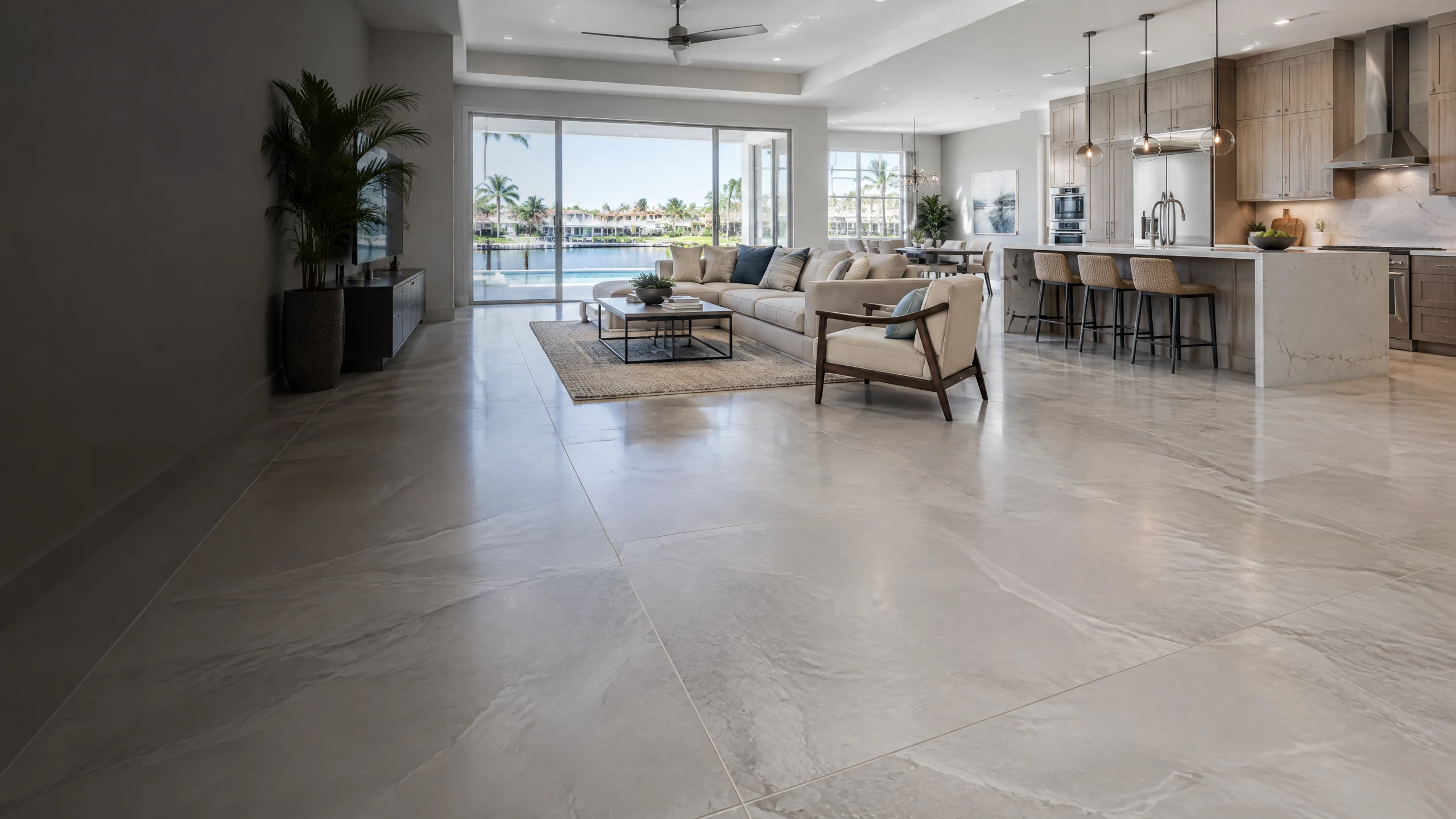
A quiet, waterproof floor, installed so it stays that way
Luxury vinyl plank has earned its place in South Florida. It is quiet underfoot, the plank itself is waterproof, it is warmer than tile, and the better products look remarkably like real wood. For condos with strict sound rules, rentals that turn over often and commercial spaces that see heavy traffic, it is often the smartest floor in the building.
The product is only half of it. Most vinyl floors that fail here fail because of what was under them: a slab that was never flat, moisture that was never tested, an underlayment that did not meet the building's sound rule, planks run tight to the walls with no room to move, or cheap material laid in front of a west-facing slider.
J. Perry & Sons installs luxury vinyl plank (LVP) and luxury vinyl tile (LVT) for homeowners, condo owners, property managers, builders and commercial owners across Broward and Palm Beach. We supply the vinyl, prepare the slab, install the sound underlayment your association requires, and finish the transitions, baseboards and stairs so the whole floor reads as one.
Thinking about vinyl for your home, condo or building? Send us your project with photos and the rooms you want done.
What we install
- Luxury vinyl plank (LVP). Wood-look planks in standard and extra-long, extra-wide formats, for living areas, bedrooms, kitchens and whole homes.
- Luxury vinyl tile (LVT). Stone- and concrete-look tiles, and glue-down LVT for commercial spaces.
- Rigid-core click floors. Floating planks with a stone-polymer (SPC) or wood-polymer (WPC) core, often with an attached acoustic pad.
- Glue-down vinyl. Thinner, fully bonded planks and tiles for commercial areas, high-traffic rooms and spaces where rolling loads or heavy furniture would move a floating floor.
- Vinyl stairs. Vinyl treads, risers and matching stair noses over concrete or wood stairs, so the stair matches the floor.
- Commercial LVT. Offices, retail, medical and dental suites, multifamily corridors and amenity rooms. See our commercial flooring page.
Vinyl is one part of our wider flooring installation work. We also install porcelain tile, natural stone and engineered wood flooring, so the recommendation you get is based on the room, not on the one product we sell.
Wear layer, core and format: choosing the right vinyl
Two vinyl planks can look the same in a showroom and perform very differently on your floor. Three things matter most.
Wear layer. The clear top layer that protects the print, measured in mils. A thicker wear layer resists scratches and scuffs from pets, chairs and sand. Residential floors in busy homes and rentals call for a heavier wear layer, and commercial floors call for a commercial-rated one.
Core. Rigid-core SPC planks are dense and stable, and handle Florida temperature swings well. WPC planks are a little softer and warmer underfoot. Flexible glue-down vinyl is thinner and bonds to the slab, which suits commercial floors and areas with heavy rolling loads.
Format and look. Longer, wider planks with varied boards look more like real wood and show fewer repeats. Painted or micro-beveled edges add realism. We bring samples to your home so you can see them in your own light, next to your cabinets and walls.
| Rigid-core click (SPC/WPC) | Glue-down LVP/LVT | |
|---|---|---|
| Installation | Floating, locks together over underlayment | Fully bonded to the slab |
| Best for | Homes, condos, rentals | Commercial, high traffic, rolling loads |
| Sound | Attached or separate acoustic pad | Paired with a bonded acoustic underlayment where required |
| Slab tolerance | Needs a flat slab | Needs a flat, smooth slab |
| Repairs | Planks can be replaced by unlocking a run | Individual planks can be cut out and replaced |
Floor prep: self-leveling underlayment for vinyl
Vinyl is thin and it shows everything underneath. A dip in the slab becomes a soft spot that flexes the locking joints. A ridge telegraphs through as a line in the light from a sliding door.
After the old floor is removed, we check the slab with a laser across the whole area and grind the high spots. For vinyl, low spots and uneven slabs are corrected with self-leveling underlayment, poured to bring the floor within the manufacturer's flatness tolerance. Self-leveler is the right product for vinyl because it gives a smooth, thin, flat base. Under tile and stone, we level with mortar instead; see our floor leveling page.
Moisture matters just as much. South Florida slabs hold water, and a slab on grade can push moisture up into the floor. We test the slab before installation and use the moisture barrier, underlayment or adhesive the manufacturer requires for the reading we get. Our article on self-leveling underlayment and floor leveling explains the process in more detail.
Vinyl in condos: sound underlayment and the IIC your building requires
Most South Florida condo associations require a sound-rated underlayment under any hard floor above the ground level, and they set the minimum rating in writing. IIC (Impact Insulation Class) measures footsteps and dropped objects; STC (Sound Transmission Class) measures voices and television. A higher number means less sound reaches the unit below.
Vinyl has an advantage here, because a quality acoustic underlayment and a vinyl floor together can reach the ratings many buildings require with very little added height. That helps with door clearances, appliance heights and transitions to hallways and balconies.
Before we quote a condo floor, we read the association's written flooring rule and select an underlayment whose tested assembly meets it. Then we:
- Prepare the product data and test report for the association's alteration package.
- Install the underlayment to the manufacturer's instructions, with the perimeter isolated so sound cannot travel around it into the walls.
- Leave the expansion gap the vinyl requires and cover it with baseboard or quarter round, never caulk that bridges the floor to the wall.
- Protect elevators, hallways and common areas, and follow the building's working rules.
If your building requires a field sound test after installation, we plan the assembly for it. A certificate of insurance is available on request. See our condo flooring page and our guide to condo flooring rules, STC and IIC.
Rentals, turnovers and multifamily
For owners of rental homes, condos and apartment buildings, vinyl is a practical floor: waterproof planks, quick to clean, and easy to repair one section at a time.
We install vinyl in single rental units and across multifamily buildings, with one product and color specified for the property so repairs and future units match. Damaged planks can be replaced without redoing the room. For property managers and owners planning several units, see our multifamily and apartment flooring page and our article on apartment turnover flooring cost per unit.
Vinyl stairs, transitions and finishing
A vinyl floor that stops at a carpeted or tiled stair always looks unfinished. We install vinyl treads and risers with matching stair noses over concrete and wood stairs, so the floor carries up the staircase. Each tread is fully bonded, the nose is fastened tight to the edge, and the cuts are scribed to the walls and stringers. Vinyl stairs are priced per step.
At doorways, balconies and changes in material, we use transitions matched to the floor color and height. Baseboards and quarter round are installed or replaced so the expansion gap is covered cleanly. Where a wood or tile stair suits the house better, see our stairs page.
Sun, heat and water: making vinyl last in Florida
- Sun and heat. Direct sun through sliding doors can fade lower-grade vinyl and expand the planks. We recommend products rated for it, leave the correct expansion gaps, and suggest window treatments in rooms that get strong afternoon sun.
- Water. The plank is waterproof, but a floating floor is not a shower pan. Water from a leak can run under the floor and stay on the slab. In bathrooms and laundry rooms we seal the perimeter as the manufacturer allows, and we discuss where tile is the better choice.
- Heavy items. Kitchen islands, built-ins and heavy furniture can pin a floating floor. We plan the layout so the floor can move, or use glue-down vinyl where weight requires it.
Vinyl flooring starting prices
| Vinyl work | Starting price |
|---|---|
| Removal of existing tile and thinset | Starting at $5 per sq ft |
| LVP and LVT installation, with slab prep and sound underlayment | Priced in your written proposal after the project review |
| Vinyl stairs, treads, risers and stair noses | Priced per step in your written proposal after the project review |
These are starting points. The final price is based on the product you choose, the slab condition and leveling required, the underlayment your building specifies, the stairs and transitions, and access at the property, and it is set in a written proposal after the project review.
Licensed, insured and permitted
J. Perry & Sons is a licensed Florida General Contractor (CGC1540699). We are licensed and insured and provide a certificate of insurance on request. We pull every permit our work requires and follow city, county and association requirements. More than 150 projects completed, backed by a workmanship warranty.
Next step Call (561) 556-7509 or Send us your project. Share photos of the rooms and stairs, your association's flooring rule if you live in a condo, and the look you want, and we will call you back personally to set up your Free Project Review.
Vinyl and LVP flooring FAQ
Do you install luxury vinyl plank?
Yes. We supply and install LVP and LVT for homes, condos, rentals and commercial spaces, including slab prep, sound underlayment, transitions, baseboards and vinyl stairs.
Is LVP a good choice for a South Florida condo?
Often, yes. With the right acoustic underlayment, vinyl can meet many association sound ratings with very little added height. We read your building's written rule and select an underlayment whose tested assembly meets it.
What IIC rating does my condo need?
The rating is set by your association's written flooring rule, not by the flooring product. We collect the rule, match the underlayment to it and prepare the documents for the association's approval package.
Do you level the floor before vinyl?
Yes. Vinyl shows every dip and ridge in the slab. We laser-check the floor, grind high spots and pour self-leveling underlayment to bring the slab within the manufacturer's tolerance.
Can you install vinyl on stairs?
Yes. We install vinyl treads, risers and matching stair noses over concrete and wood stairs, so the stairs match the floor. Vinyl stairs are priced per step in your written proposal.
Is vinyl flooring waterproof?
The plank is waterproof, which makes it a strong choice for kitchens, rentals and busy homes. Water from a leak can still get under a floating floor, so we seal the perimeter as the manufacturer allows and recommend tile in wet areas where it fits better.
Do you install commercial LVT?
Yes. We install glue-down LVT and vinyl plank in offices, retail, medical suites and multifamily buildings, with night shifts where the building requires them.
How much does LVP installation cost?
After the project review, your written proposal lists the following scope and pricing: LVP and LVT installation, based on the product, the slab condition, the underlayment and the stairs. Removal of an existing tile floor starts at $5 per sq ft.
Guide
Request the guide: Condo Floors: Sound Rules, Vinyl and Porcelain
Call (561) 556-7509 or send us your project for a Free Project Review.