"The shell is in, bonding passed, the owner wants to swim, and my concrete sub just pushed me again. I need someone who can form the beam edge to my detail, pour the deck to slope, and show up when the inspection is on the calendar."
That is the call we get from pool builders and general contractors, and this page is written for you. The concrete pool deck is the part that carries the finish, sheds the water and takes the heat. When it is formed and poured right, the coping stays tight, the tile line stays clean and the owner never calls you back about a crack at the beam.
Short answer: J. Perry & Sons forms and pours concrete pool decks, pool beam edges, cantilever edges, deck extensions and deck drains across Broward, Palm Beach and Miami-Dade as a forming and concrete trade contractor for pool builders and GCs. We price forming by the linear foot, decks by the square foot and drains by the linear foot, so our numbers drop straight into your pool contract. A certificate of insurance naming you and the owner goes out before we mobilize.
Plan My Pool Deck · Call (561) 556-7509
This page is part of our concrete restoration and structural concrete work. The slab we pour is ready for a broom finish, stamping, a spray texture, or pavers and travertine on top. Homeowners replacing a deck around an existing pool should start at pool deck pavers or pool deck resurfacing.
Licensed and insured. Certificate of insurance available on request.
Pool Decks and Coping: A South Florida Owner's Guide
How to choose a pool deck and coping that stay cool, safe and solid.
What we do for pool builders and GCs
Forming only. Deck perimeter and pool beam edge, set to grade and string line, braced and ready for your pre-deck inspection.
Form and pour. Forms, base, reinforcement, joints, drains and the pour, finished to the spec.
Full deck package. Demolition of an old deck, base correction, forming, drains, pour and finish, so the deck is one line in your contract instead of four.
Edge details. Flat edge ready for paver or stone coping, a formed cantilever edge, or a bullnose edge poured together with the deck.
Extensions. New sections doweled into an existing deck, with drains and finish matched as closely as concrete allows.
Deck drains. Channel drains set in the forms before the pour and tied to the outlet.
Paver-ready and travertine-ready slabs. Screeded flat to slope so the stone crew can set in mortar or adhesive without fighting the slab.
We price each scope per unit on an itemized proposal, and the final number is based on access, the base we find, the edge detail and the finish. GCs carrying a larger concrete package can see how we bid and schedule on our structural concrete subcontractor page.
Next step: send the pool plan or the deck detail sheet, and we will return forming and pour prices per unit.
How we form and pour a pool deck
A pool deck looks simple: a flat slab around water. Most of the problems we get called to fix started underneath it or at the pool edge. Here is the order we follow.
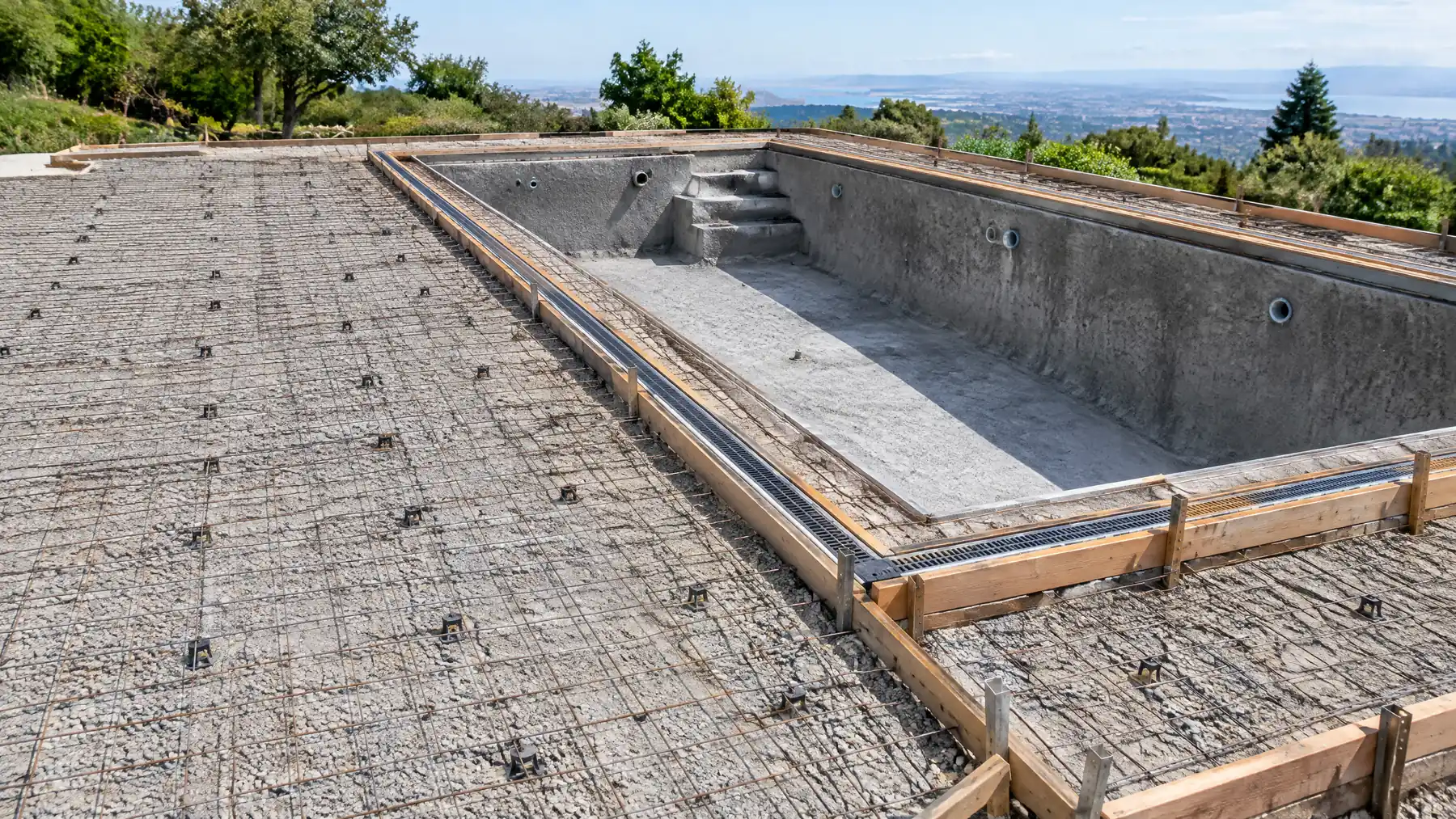
- Base and compaction. The fill around the shell goes back in lifts, layers a few inches thick, and each lift is compacted with a plate tamper or jumping jack. The backfilled strip right next to the pool wall gets the most attention, because that is where settlement shows first. Soft spots are dug out and replaced. Loose spoil from the dig does not go back under the slab; compacted fill does.
- Forms and pool beam edge. Perimeter forms are set to grade and string line. At the pool, the edge is formed to the builder's detail. Forms are braced so the edge holds a straight line while the concrete goes in.
- Reinforcement. Welded wire mesh up on chairs so it sits inside the slab, not on the dirt; rebar where the plans call for it; or fiber-reinforced concrete when the pool builder's spec allows it. On an extension, steel dowels drilled into the old slab tie the new section to it.
- Expansion joints at the beam. A flexible expansion joint separates the deck from the pool beam so the two can move on their own.
- Control joints. Tooled or saw-cut at the spacing the slab needs, so cracks happen where we want them.
- Slope and drainage. The deck pitches away from the pool and away from the house toward deck drains, the yard or a swale, typically about 1/8 to 1/4 inch per foot. Drain channels are set in the forms before the pour.
- Pour and finish. Broom finish for a slip-resistant bare deck, a stamped pattern, a flat screeded slab for pavers, or a slab prepared for spray-deck texture.
Forms set and an inspection on the calendar? Call (561) 556-7509 and we will line up our crew behind it.
The beam edge: where most deck problems start
Owners do not call you about the middle of the deck. They call about the edge: a crack along the tile line, coping that popped, a deck that settled toward the water. Those problems almost always trace to three things at the beam.
Missing or failed expansion joint. The deck and the pool shell move differently with heat and settlement. When they are poured tight against each other, the deck pushes on the beam until the coping and the tile line crack. We separate them with a flexible joint every time. When an old joint has failed, our expansion joint sealing crew can reseal it.
Soft backfill next to the wall. The strip between the excavation and the shell is the hardest to compact and the first to settle. We compact it in lifts with equipment that fits the gap, not by driving over it.
Edge formed off-line. A wavy beam edge shows through every piece of coping set on it. We string-line and brace the forms so the edge is straight before the pour, not fixed after.
Next step: if you have a callback at the beam on a deck someone else poured, send photos. We will tell you whether it is a joint, a base or a forming problem.
Finish options and cure time
The right finish is based on the budget, how hot the deck gets in the afternoon sun and what goes on top later.
Broom finish. The lowest-cost and most slip-resistant bare concrete. It is often sealed.
Stamped concrete. Color and a pattern pressed into the fresh slab, then sealed.
Spray-deck or cool-deck. A textured cement-based coating sprayed on a cured slab. It stays noticeably cooler under bare feet.
Travertine-ready or paver-ready slab. Screeded flat to slope so travertine or porcelain pavers can be set in mortar or adhesive. Our pool remodeling page covers the deck, coping and tile work that goes on top.
Cure time before covering. New concrete needs time before anything covers it. As a general guide, plan on at least 7 days before pavers or stone are set in mortar, and around 28 days before a coating or sealer goes on, unless the coating maker allows sooner. In our humid climate we test the slab for moisture before any coating.
If the existing deck is sound and only the surface is tired, pool deck resurfacing may cost the owner less than a new pour.
Working as your sub: what you can count on
Scheduling to your inspections. We schedule after the shell, plumbing and electrical bonding are inspected, and we have the forms ready for your pre-deck inspection.
Unit pricing. Forming by the linear foot of deck perimeter and pool beam edge, decks by the square foot, drains by the linear foot. Your estimator can drop our numbers straight into the pool contract.
Paperwork up front. A certificate of insurance naming the builder and the owner goes out before we mobilize. We are licensed and insured with workers' compensation, and we have 150+ projects completed.
Commercial and multifamily pools. Hotel, condo and multifamily pool decks are larger and often have residents or guests around them. We phase the work, protect access routes and work night shift on commercial jobs when the property needs the pool area open by day.
Your detail, not ours. We build to your plans and to the engineer's drawings when there are structural details. We flag any conflict between the detail and the site before we pour, not after.
Related concrete work on the same job. Concrete cutting and core drilling for cutting out old decks and trenching for drains, and CMU block wall reinforcement for raised spa walls, planters and block retaining walls.
Pool builder with shells on the schedule? Call (561) 556-7509 or send us your project with the plan, and we will return forming and pour prices per unit.
Permits and inspections
On a new pool, the deck and the pool barrier usually fall under the pool permit, with inspections for bonding and for the deck before the pour, and a final once the barrier is in. A standalone deck extension or replacement may need its own permit, based on the city and on whether drainage or bonding is changing. J. Perry & Sons pulls its own permits when the deck is our contract and follows every city and county requirement. Equipotential bonding, the grid that keeps the pool area at one electrical potential, is a licensed electrician's scope, and we do not pour until it has passed inspection. Miami-Dade and Broward are in the High-Velocity Hurricane Zone; Palm Beach County is not, and each city applies its own requirements. More on how we handle this on our permits and compliance page.
What a pool deck proposal includes
- Deck area, pool beam perimeter and any extension area
- Demolition and haul-away of the old deck, if there is one
- Base, compaction and soil corrections
- Forms, edge detail and coping prep
- Wire, rebar or fiber, and dowels for extensions
- Expansion and control joints
- Deck drains by linear foot and the outlet tie-in
- Finish type and sealer, and cure time before pavers or a coating
- Workmanship warranty terms
Related pool and concrete services
Pool deck resurfacing: a new surface over a sound existing deck. Pool remodeling: coping, pavers and the finish around the water. Concrete cutting and core drilling: cutting out old decks and trenching for drains. CMU block wall reinforcement: raised spa walls, planters and block retaining walls. Decks: when part of the yard is better as a raised deck than a slab. Association pool decks: commercial pavers and HOA pool decks.
Pool deck forming by county
We are based in Tamarac and pour pool decks in all three counties.
Pool deck concrete in Broward County: Fort Lauderdale, Hollywood, Davie, Tamarac, Weston, Pembroke Pines, Miramar, Pompano Beach, Parkland and Southwest Ranches. Pool deck concrete in Palm Beach County: Boca Raton, Delray Beach, West Palm Beach, Palm Beach Gardens, Boynton Beach, Wellington and Jupiter. Pool deck concrete in Miami-Dade County: Miami, Miami Beach, Coral Gables and Aventura.
Travertine, porcelain and pavers with coping built for the waterline.
Free project review · (561) 556-7509
FAQ
Do you do pool deck forming only for pool companies?
Yes. We form the deck perimeter and the pool beam edge, labor only, priced per linear foot, with cantilever and bullnose coping edges as their own line. We can also pour and finish, or take the full deck package. Send the plan and we will price each unit.
How do you price a concrete pool deck?
Decks are priced per square foot, forming and edges per linear foot, and drains per linear foot. The final number is based on access, the base, the edge detail and the finish, and it is set after we review the plan or the site.
Can you extend an existing pool deck?
Yes. We drill steel dowels into the existing slab to tie the new section in, match the slope and drains, and match the finish as closely as concrete allows. A new expansion joint goes in wherever the extension meets the pool beam.
Why does a pool deck need an expansion joint at the beam?
The deck and the pool shell move differently with heat and settlement. A flexible joint keeps the deck from pushing on the beam and cracking the coping and the tile line.
How long before pavers or a coating can go on new concrete?
As a general guide, at least 7 days before pavers or stone in mortar, and around 28 days before a coating or sealer, unless the product allows sooner. We test the slab for moisture before any coating.
Do you provide a certificate of insurance?
Yes. A certificate of insurance naming the builder and the owner goes out before we mobilize. We are licensed and insured with workers' compensation.