
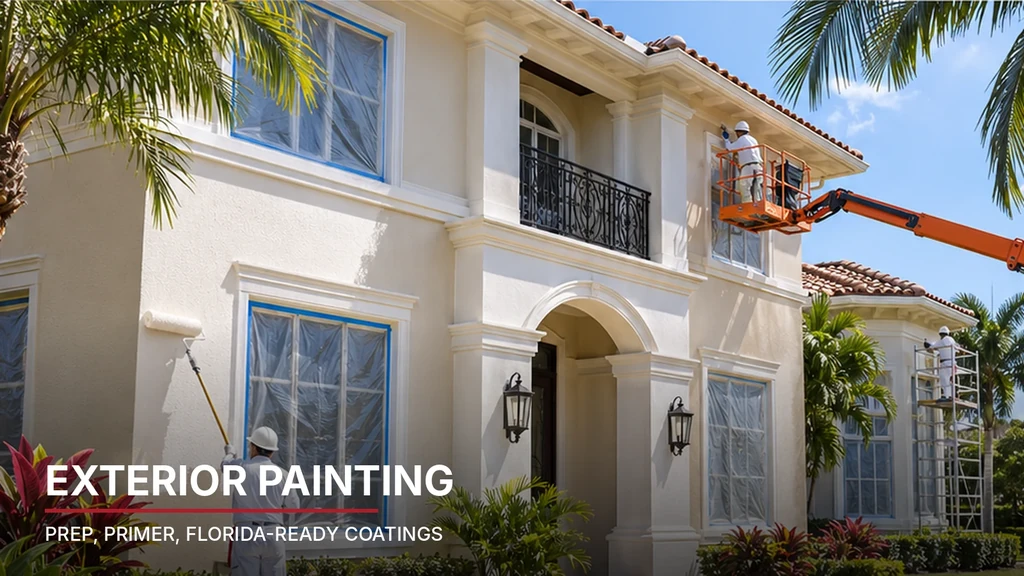
"The stucco is going up, the windows are set, and I need an exterior painting sub who will follow the spec, submit the products, show up when the wall is ready and not leave me a punch list that holds up the CO. Who prices that properly?"
That is the call we get from builders, developers and architects, and it is a different job from repainting a house that has been lived in for a long time. On new construction and major renovations, the paint goes on fresh stucco, new block, new metal, new trim and new cladding, often with other trades still on site. The risks are different: walls painted before they are ready, products that do not match the specification, colors that drift between elevations, and touch-ups after the other trades leave.
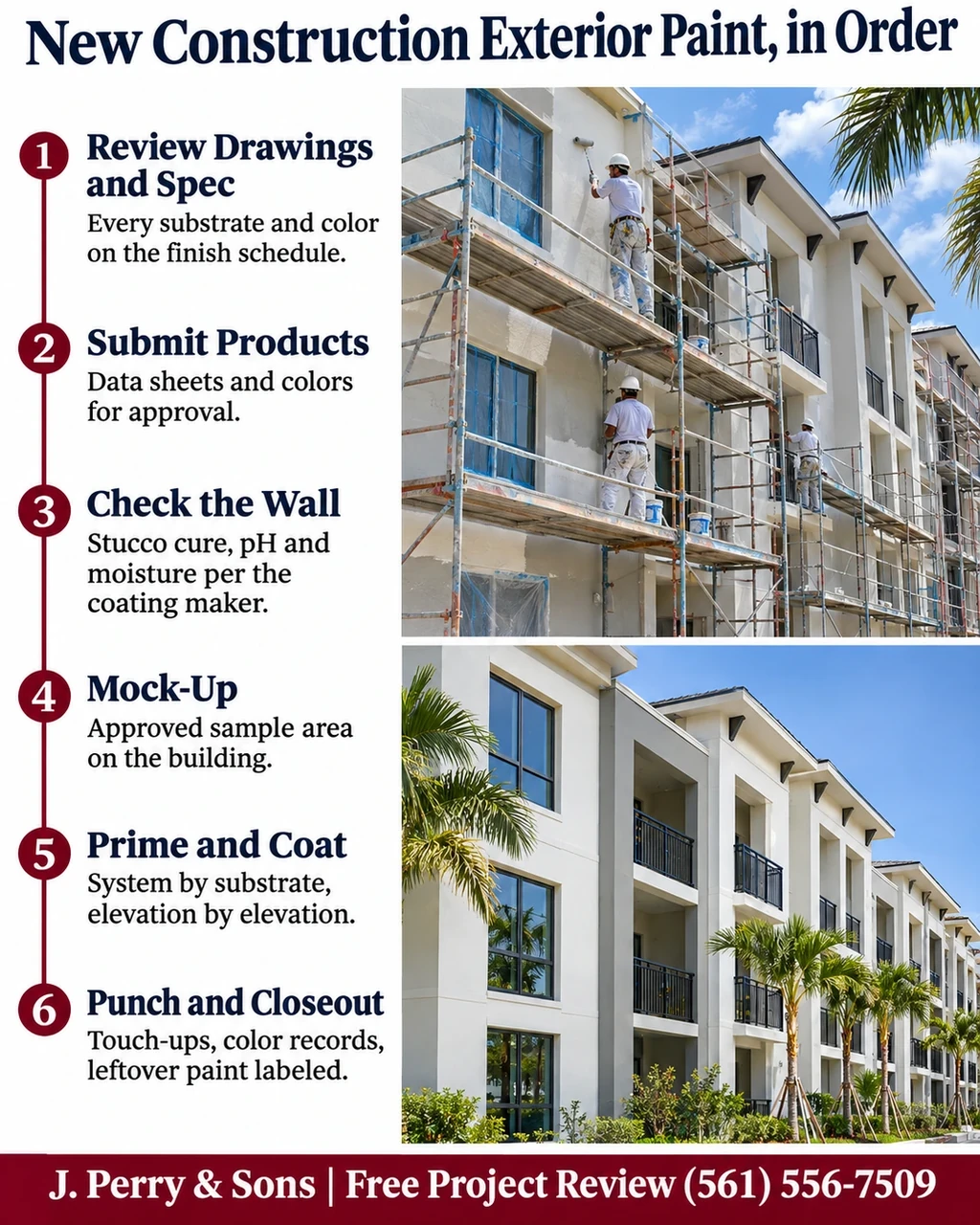
Short answer: exterior painting on new construction and major renovations means matching a coating system to every substrate on the drawings, waiting for new stucco and concrete to meet the coating manufacturer's cure and alkalinity requirements, submitting product data and colors for approval, painting a mock-up before production, and sequencing the work around windows, sealants, cladding and stone. J. Perry & Sons prices it from your drawings and specification as a licensed general contractor, and because we also do stucco, drywall, cladding and stone, we can carry the envelope finishes as one package.
We work with builders, developers, architects and designers across Broward, Palm Beach and Miami-Dade, with 150+ projects completed. Homeowners repainting an existing house will find their page at residential painting. The full range of our painting work is on painting services.
What we paint on new construction and renovation projects
On a builder or architect project, the exterior paint scope is rarely just walls. We price each of these as its own line so the scope can be checked against the drawings:
- Stucco walls. New three-coat stucco, smooth and textured finishes, accent bands, reveals and control-joint lines.
- Concrete and block. Tie beams, columns, slab edges, site walls and exposed block where the design calls for paint over masonry.
- Trim, fascia and soffits. Wood, composite and cementitious trim, fascia boards, soffit panels and decorative profiles.
- Doors and frames. Entry doors, service doors, hollow metal frames and garage doors that are field-finished.
- Metal. Railings, gates, columns, canopy steel, louvers and miscellaneous metal, with the primer the metal requires.
- Site elements. Garden walls, mailbox and monument structures, pool equipment enclosures and screen walls.
We read the finish schedule, the elevations and the specification section for exterior painting, and we flag anything that is shown on one and missing on another before we price it.
Next step: send the elevations, the finish schedule and the painting specification through our project form.
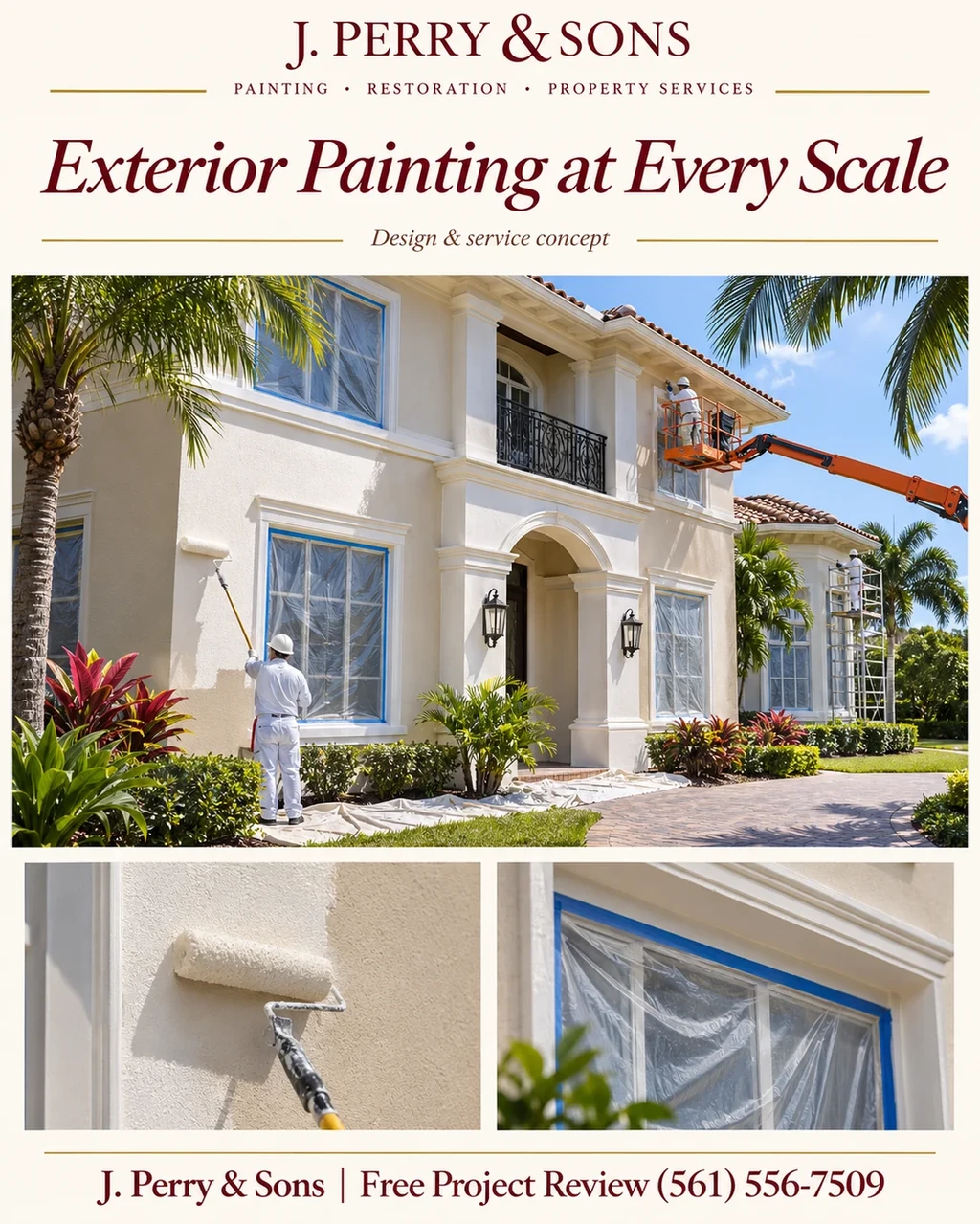
Coating systems by substrate
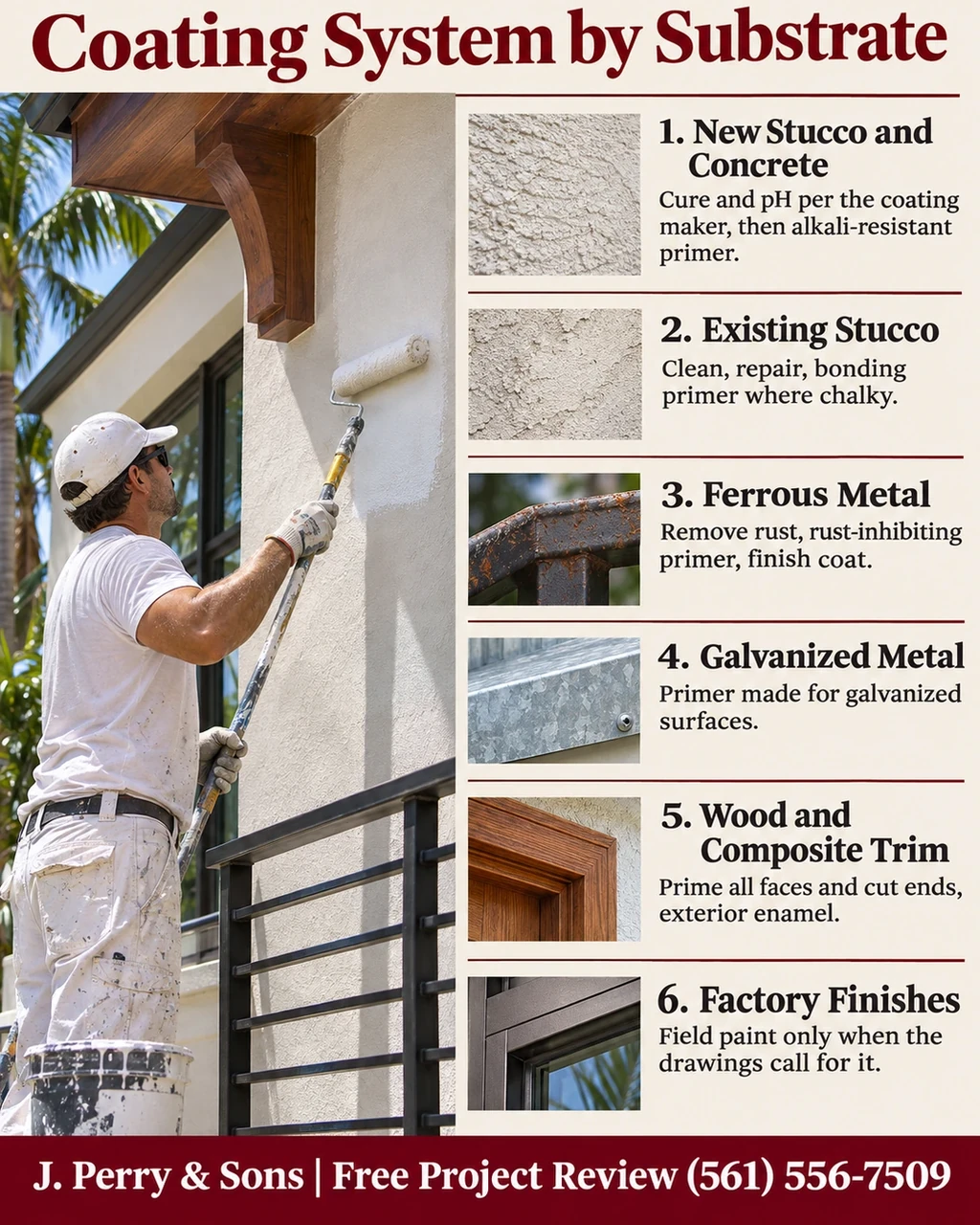
The coating system is decided by what it goes on. A specification usually names the system, and when it does, we price exactly that. When it leaves the choice open, these are the general rules we follow and put in writing.
New stucco and concrete. Fresh cementitious surfaces are alkaline and hold moisture. The coating manufacturer sets the cure and pH conditions before primer, and we follow them. An alkali-resistant primer goes on first, then the finish coats. Painting new stucco before it is ready is the most common cause of early failure on new homes: discoloration, poor adhesion and blistering.
Existing stucco on a renovation. Sound, previously painted stucco is cleaned, repaired and spot-primed or fully primed based on its condition. Chalky surfaces get a bonding or conditioning primer.
Acrylic or elastomeric finish. Acrylic coatings breathe and are the usual finish over sound stucco. Elastomeric coatings are thicker and bridge fine cracking, but they slow moisture leaving the wall, so they belong on dry, sound walls and only where the specification or the wall condition calls for them.
Ferrous metal. Rust removed, a rust-inhibiting primer, then a finish coat suited to sun and salt. Galvanized metal gets a primer made for galvanized surfaces, because standard primers can fail to bond.
Wood and composite trim. Primed on all faces where practical, especially cut ends, then finished with an exterior enamel. Composite products follow the trim manufacturer's paint requirements.
Aluminum and factory finishes. Window frames, storefront and factory-finished cladding are usually not field-painted. If the drawings call for it, we price the primer and finish the panel or frame maker accepts. See our aluminum composite panels page for the cladding side.
Next step: if the specification leaves the system open, tell us and we will propose one in writing with the product data attached.
New stucco: when the wall is ready for paint
The stucco schedule and the paint schedule are tied together, and a builder who wants a clean exterior has to protect that gap.
Cure and alkalinity. The coating maker's data sheet states when new cementitious surfaces can be primed. We check the wall against it before we start, not against the calendar on the site board.
Moisture. A wall that was just rained on, or stucco that is still damp inside, is not ready even if the surface looks dry. We check before primer goes on.
Finish and texture. The stucco finish affects how paint reads. A smooth stucco finish shows every trowel mark and patch under raking light, so it takes extra care in both trades. See smooth stucco finish and new construction stucco.
Patches and repairs. Patches from window installation, penetrations and damage are allowed to cure before priming, or they show through as a different color and sheen. This is called flashing, and it is avoided with primer and timing, not with an extra finish coat.
Because our own crews do stucco, we know what the wall needs before it is painted. When the stucco is by others, we inspect it before we start and report problems in writing so they are fixed by the right trade.
Next step: send the stucco schedule with your drawings so we can plan primer to follow cure, not the other way around.
Submittals, mock-ups and color control
Architects and owners expect the paint to match what was approved. That starts with paperwork and a sample on the wall.
Product submittals. Product data sheets for each primer and finish, the system by substrate and the color schedule, submitted for approval before ordering.
Color samples. Draw-downs or sample boards in the specified colors and sheens. Color on a small chip reads differently from color on a large stucco wall in full sun, so we recommend testing on the building.
Mock-up. A sample area on the building, painted with the approved system, colors and sheen, so the architect, designer and owner approve the finish in real light. That area becomes the standard the rest of the building is checked against.
Batch control. Large buildings use a lot of paint. We keep the same product and color formula across elevations and record what went where, so touch-ups match.
Simple rendering. When a color decision is still open, we can prepare a simple rendering. Detailed design work is done by the designer on our team as a separate scope.
Next step: tell us who approves submittals on your project and we will format them to your process.
Sequencing with windows, sealants, cladding and stone
Exterior painting is close to the end of the envelope sequence, and it goes wrong when it is scheduled out of order.
- Windows and doors before paint. Openings are installed and the stucco returns finished first. See impact window replacement for that scope.
- Sealants and paint. The specification decides whether sealant goes on before or after paint and which sealants accept paint. We follow it, and we do not paint over sealants that are not paintable. See window and door perimeter caulking.
- Stone and cladding. Natural stone veneer and aluminum cladding are installed and protected, and the paint line at each edge is set before production. We install real natural stone veneer only. See exterior house stone veneer.
- Hardscape after or protected. Pavers, driveways and pool decks are either finished after paint or covered before it, so overspray and wash water do not reach them.
- Landscaping last. New plants and irrigation near the walls go in after painting, or irrigation stays off while walls are coated.
As a general contractor, we can carry several of these trades ourselves: stucco, stone veneer, aluminum cladding and painting. That reduces the hand-offs where the finish gets damaged.
Next step: send your schedule and we will mark where paint fits in it.
Access and equipment
Most single-family and low-rise work is reached from ladders, scaffolding and lifts. Our commercial painters, frame scaffolding and airless spray rigs are our own. Boom and scissor lifts are rented by phase. Swing-stage and rope-access work is by licensed trades, coordinated by J. Perry & Sons.
Spray, brush and roll. Large stucco elevations are typically sprayed and back-rolled where the system or texture calls for it. Trim, doors and metal are brushed or sprayed based on the finish required.
Overspray control. Windows, glazing, stone, cladding, hardscape and neighboring property are masked and protected before spraying. Wind is checked during the work.
Taller buildings and towers are covered on our high-rise and condo painting page. Plazas, offices and retail buildings are on commercial painting.
Next step: tell us the building height and site access so the access plan is part of the price.
Who does what
| Scope | Who does it |
|---|---|
| Coating specification and colors | Your architect or designer |
| Product submittals, mock-up | J. Perry & Sons |
| Stucco repair before paint | J. Perry & Sons, or the stucco trade on your project |
| Sealants at openings | Per your specification and the scope split |
| Exterior painting, all listed substrates | J. Perry & Sons |
| Swing-stage and rope access, where needed | Licensed trades, coordinated by J. Perry & Sons |
| Punch list and closeout touch-up | J. Perry & Sons |
We do not set structural details or envelope design. We build to the drawings and the specification and report conflicts before work starts.
Next step: send the scope split from your contract so our proposal matches it line for line.
Punch list and closeout
The paint is the last thing the owner sees, so it is where the punch list concentrates.
Touch-up after other trades. Fixtures, lights, address numbers and hardware are installed on painted walls, and those trades leave marks. We plan a touch-up pass after them, with the original product and color.
Raking-light walk. We walk the elevations in strong side light, because that is when patches, lap marks and texture changes show.
Closeout package. A record of the products, colors, sheens and where each was used, plus labeled leftover paint for the owner. That record is what the next painter will need.
Next step: tell us what your closeout package requires and we will include it in the proposal.
Licenses, insurance and permits
- Licensed general contractor. J. Perry & Sons Inc, CGC1540699.
- Licensed and insured. Certificate of insurance available on request, with additional insured wording when your contract requires it.
- Permits. J. Perry & Sons pulls all permits itself and follows every city and county compliance requirement. Repainting alone often needs no permit, while the repairs and other envelope work found or specified on the project may.
- Itemized proposal. Each substrate, system, area and exclusion is its own line.
For more on working with us as a trade partner, see our subcontractor page for general contractors.
Starting price
Exterior painting on new construction and renovation projects is priced from your drawings, specification, substrates, height and access. Pricing is given in the itemized written proposal after we review the project. For general cost background, our homeowner articles on exterior painting costs in South Florida and the exterior painting guide for South Florida explain what moves the number.
Next step: send the drawings and specification through our project form.
Exterior painting by project type
- Existing homes, repaints and HOA color approval: residential painting
- Offices, retail and warehouses: commercial painting
- Condo towers and tall buildings: high-rise and condo painting
- Interiors on the same project: interior painting
- Building washing before a repaint: pressure washing for buildings
Licensed and insured. Certificate of insurance available on request.
Frequently asked questions
When can new stucco be painted?
When it meets the coating manufacturer's stated cure, alkalinity and moisture conditions. We check the wall against the product data sheet before primer goes on. Painting too early causes discoloration and poor adhesion.
Do you follow the architect's paint specification?
Yes. We price and install the specified system, submit product data and colors for approval, and paint a mock-up before production. If the specification leaves a choice open, we propose a system in writing.
Can you substitute products?
Only through the approval process on your project. We submit the substitution with product data and wait for written approval.
Do you paint aluminum windows or cladding?
Factory finishes are usually left as they come. When the drawings call for field painting, we use the primer and finish the manufacturer accepts.
Do you work as a trade contractor to the GC?
Yes. We price our trades from your drawings and scope split and work to your schedule. We can also carry stucco, stone veneer and aluminum cladding with the paint.
Who handles the punch list?
We do. A touch-up pass after the finish trades and a raking-light walk are part of our scope, with the original products and colors.
Do you provide a certificate of insurance?
Yes, on request with the proposal, with additional insured wording when your contract requires it.