
"I need more than one trade. The kitchen, the floors, maybe the windows and the outside of the house. I don't want to hire five people, chase five schedules and find out at inspection that nobody pulled the right permit. I want one licensed company that answers for all of it."
That is what a general contractor is for.
Short answer: a general contractor is the licensed company that signs one contract with you, pulls the permits in its own name, runs the trades in the right order, passes the inspections and closes the project out. J. Perry & Sons is a state-licensed general contractor (CGC1540699) in Tamarac, serving Broward, Palm Beach and Miami-Dade. Our own crews do the finish trades most projects are built from, such as tile, stone, flooring, drywall, stucco, painting, pavers and concrete, and the trades that need their own license (electrical, plumbing, HVAC, roofing) come in by licensed trades, coordinated by J. Perry & Sons.
We supply all the materials on our projects, from the preferred brands we work with, so one company is responsible for what goes in and how it is installed.
We have completed 150+ projects. Licensed and insured. Certificate of insurance available on request.
If you are looking for a contractor close to home for a specific remodel, our renovation contractor near me page covers that. This page explains what a general contractor actually does for you, how to check one and how we run a project from the first photo to the final inspection.
Next step: write down every part of the house you want to change, even the ones you are not sure about yet. That list is the start of the scope.
What a general contractor does that a trade crew does not

A tile setter sets tile. A painter paints. Both can be excellent, and neither is responsible for the project as a whole. A general contractor is.
One contract and one point of contact. You sign one agreement with one company. Questions, changes and decisions go through one person, not through five phone numbers.
Permits in the contractor's name. The general contractor applies for the building permit, signs as the responsible contractor and is the name the building department holds to the code. When the permit is in our name, the responsibility is ours.
Sequencing. Projects fail at the hand-offs: the drywall closed before the plumbing inspection, the floor installed before the cabinets were set, the stucco patched before the new windows went in. A general contractor plans the order so each trade builds on finished, inspected work.
Coordinated licensed trades. Electrical, plumbing, HVAC and roofing each require their own state license in Florida. A general contractor brings in the licensed contractor for each one and coordinates their work and their inspections inside the same project.
Inspections and closeout. The GC schedules the inspections, meets the inspector, corrects anything flagged and closes the permit. An open permit can follow a house into a sale or a refinance, so closing it matters.
Protection of the rest of the house. Floors, furniture, landscaping and the parts of the home you still live in are protected, and the site is kept clean.
Next step: ask any contractor you are talking to which of these six items they will be responsible for, and get the answer in writing.

Hiring a general contractor vs hiring each trade yourself
Some homeowners save money hiring trades directly on a small job, and on a one-room repaint that can make sense. On a project with several trades, permits and inspections, it usually costs more than it saves.
| Question | Hiring each trade yourself | One general contractor |
|---|---|---|
| Who pulls the permit? | You, or each trade separately, or nobody | The GC, in its own name |
| Who sets the order of work? | You | The GC |
| Who fixes a conflict between trades? | You, between two companies | The GC |
| Who answers to the inspector? | Whoever showed up | The GC |
| How many contracts? | One per trade | One |
| Who carries the project insurance? | Each trade, if they have it | The GC, with proof on request |
There is also the owner-builder route, where the homeowner pulls the permit personally. Florida allows it under specific conditions, and it makes the homeowner the responsible party for the code, the inspections and the people working on the property. Before you choose it, read our guide on why it matters who pulls the permit.
Next step: if you already have quotes from separate trades, send them. We will tell you what is missing between them.
How to check a general contractor in Florida
Anyone can call themselves a contractor on a website. In Florida, a general contractor license is issued by the state, and you can check it in a few minutes.
- Look up the license number. It should appear on the proposal, the contract and the website. Ours is CGC1540699. Our guide to verifying a Florida contractor license shows where to look it up and what the record tells you.
- Match the name. The company name on the license record should match the company on your contract.
- Ask for the certificate of insurance. General liability and workers' compensation. We provide ours on request with the written proposal.
- Ask who pulls the permit. The answer should be "we do, in our name". If it is "you can pull it" or "it doesn't need one", stop.
- Ask which trades they do themselves. A GC that self-performs the main finish trades controls the quality of what you see every day.
- Ask which trades go to partners, and whether those partners are licensed. Electrical, plumbing, HVAC and roofing must be.
- Read the proposal line by line. It should be itemized. A single lump sum with one sentence of scope is hard to compare and hard to hold anyone to. Our guide on what to look for in a renovation contract walks through it.
Next step: use this list on every contractor you interview, including us.
What we build ourselves and what licensed specialty contractors do
Most general contractors subcontract almost everything. J. Perry & Sons started in the finish trades and still self-performs them, which is why the parts of a project you look at and walk on every day are built by our own crews.
| Scope | Who does it |
|---|---|
| Demolition, tile, natural stone, stone veneer, flooring, terrazzo | J. Perry & Sons crews |
| Drywall, Level 5 finishing, metal framing, ceilings | J. Perry & Sons crews |
| Stucco, painting, aluminum cladding, wall panels | J. Perry & Sons crews |
| Pavers, pool decks, driveways, concrete and balcony restoration, CMU block | J. Perry & Sons crews |
| Impact windows and doors, decks, pergolas, railings, outdoor kitchens | J. Perry & Sons crews |
| Electrical, plumbing, HVAC, roofing | Licensed trades, coordinated by J. Perry & Sons |
| Waterproofing membranes, marine work, seawalls | Licensed trades, coordinated by J. Perry & Sons |
| Structural design, engineering, architectural drawings | Your engineer or architect; we build to their drawings |
We are a builder, not an engineer or an architect. When a project changes structure, such as a new opening in a block wall, a removed wall or a new beam, the design comes from a licensed engineer, and we build to the stamped drawings.
Next step: tell us which of these scopes your project touches, and we will tell you who would do each one.
How a project runs with us
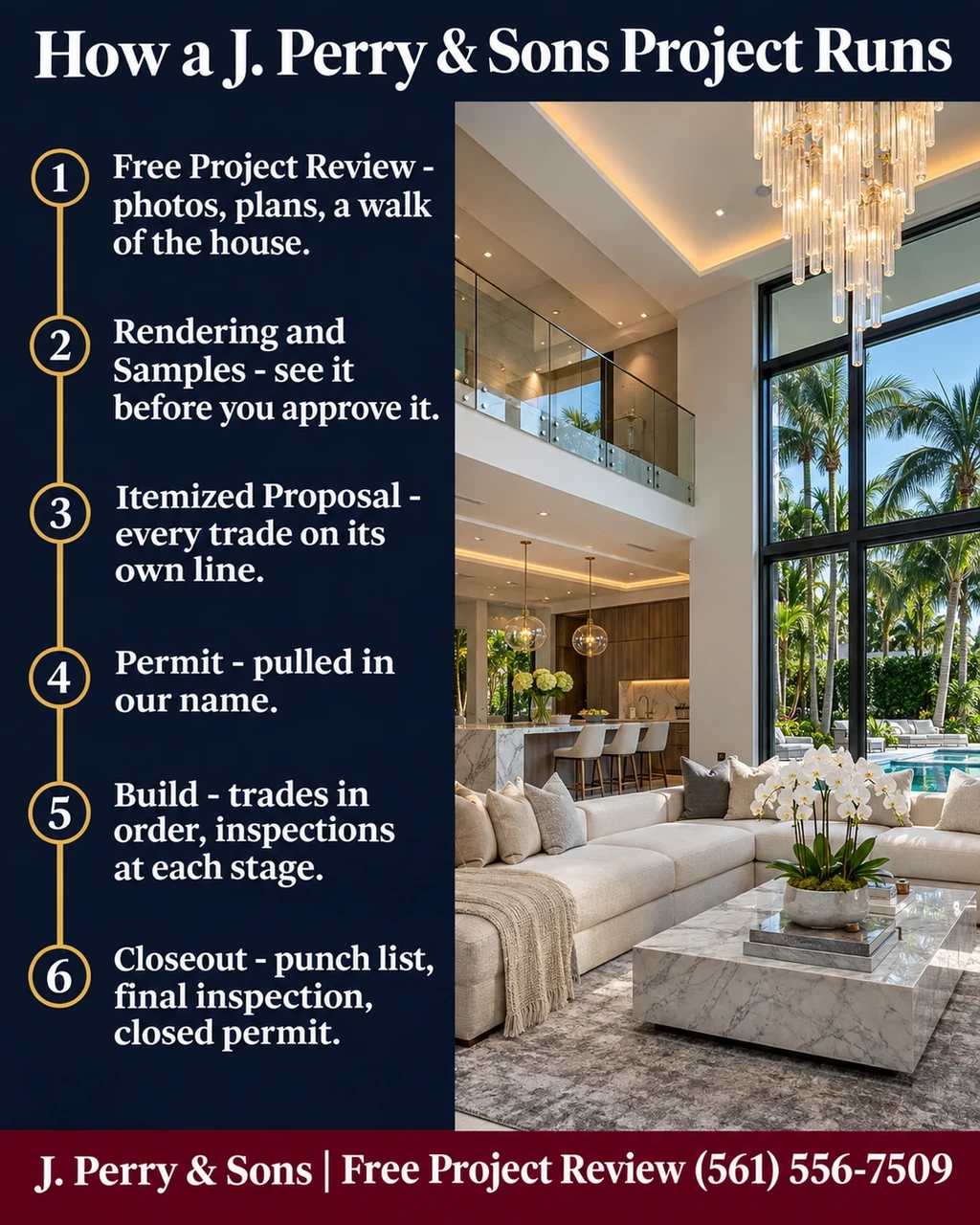
Every project follows the same order, whether it is one bathroom or the whole house.
1. Free Project Review. You send photos, plans or a list of what you want. We look at the house with you, talk through what is possible and tell you a starting price.
2. Rendering and samples. Once you sign the proposal, a simple rendering is included to give you an idea of the finished space. We bring material samples to your home so you choose tile, stone and finishes in your own light. A more detailed design is done by the designer on our team as a separate scope. See renderings and samples.
3. Itemized written proposal. Each trade and each area on its own line, with what is included and what is not. You receive a written estimate after the site review on most residential projects.
4. Permit. We prepare the permit application, submit it in our name and follow the city or county requirements. Where a Notice of Commencement is required, we explain it before it is recorded. Our permits and compliance page covers how we handle this.
5. Build. Trades go in the planned order, inspections happen at the stages the permit calls for, and you have one person to call.
6. Closeout. Punch list walked with you, site cleaned, final inspection passed and the permit closed.
Next step: send what you have now, even if it is only photos. Drawings are not needed to start the review.
Homes and condos: what changes
Single-family homes. Most of our residential work is in single-family homes, where a project can reach both the interior and the exterior. Many homes in our area are also in HOA communities, which review exterior colors, materials, windows and hardscape. We prepare the information the HOA asks for alongside the permit.
Condos. A condo renovation adds the association to the process: an alteration application, a certificate of insurance naming the association, work hours, elevator reservations and often sound-control rules for hard floors. Our checklist of condo renovation rules in South Florida lists what boards usually ask for.
Inside or outside. If your project is mostly inside the house, start with interior renovation: kitchens, bathrooms, floors, drywall, stairs and ceilings. If it is the outside of the house, start with exterior renovation: stucco, painting, stone, cladding, windows, pavers and outdoor living.
Next step: if you live in a condo or an HOA community, send the association's renovation rules with your first message.
For business and building owners
J. Perry & Sons also works directly for commercial owners and property managers on offices, retail, restaurants, healthcare spaces, multifamily and common areas. Commercial jobs often run at night, so the business stays open, and our crews work night shift when the building requires it. For commercial scopes by building type, see commercial renovation. For framing and drywall packages, see metal framing.
Next step: tell us the building type, whether it is occupied and the hours the building allows work.
Starting prices
We do not publish a price for a whole house, because two whole-house projects are never the same scope. Each trade has its own starting price, and your proposal adds up the trades your project needs.
| Scope | Starting at |
|---|---|
| Kitchen renovation | $28,000 |
| Stucco repair | $1,500 |
| Impact window, single-hung | $1,600 per opening |
| Impact sliding glass door | $7,500 per opening |
| Paver driveway, concrete 80 mm | $29 per sq ft |
| Stone veneer, real natural stone, installed | $47 per sq ft |
These are starting prices. The final number is based on the size of the project, the materials you choose and the condition of what is behind the existing finishes, and it is set after we review the project with you. Bathroom renovations, interior painting and multi-room projects are priced in the itemized written proposal.
Next step: send photos of each area you want to change, and we will tell you the starting price for each one.
Related services
Frequently asked questions
What does a general contractor do?
A general contractor signs one contract with you, pulls the permits in its own name, runs the trades in the right order, coordinates licensed electricians, licensed plumbers, a licensed HVAC contractor and a licensed roofing contractor for electrical, plumbing, HVAC and roofing, passes the inspections and closes the permit. You deal with one company for the whole project.
Do I need a general contractor for a remodel?
If the project involves several trades, a permit or any structural, electrical or plumbing change, a licensed general contractor is the safer route. For a single trade with no permit, such as a repaint, a trade contractor can be enough.
How do I check that a general contractor is licensed in Florida?
Ask for the license number and look it up in the state's license records. The name on the record should match the company on your contract. Ours is CGC1540699, and our guide to verifying a Florida contractor license shows the steps.
Do you pull the permits?
Yes. J. Perry & Sons pulls all permits itself, in its own name, and follows every city and county compliance requirement.
Do you do the work yourselves or coordinate licensed specialty contractors?
Our own crews do the finish trades: tile, stone, flooring, terrazzo, drywall, metal framing, stucco, painting, pavers, concrete, decks, windows and doors. Electrical, plumbing, HVAC, roofing, waterproofing membranes and marine work go by licensed trades, coordinated by J. Perry & Sons.
Can you work from my architect's or designer's plans?
Yes. We build to the drawings and work with your architect, engineer or designer. If you do not have a designer, a simple rendering is included once you sign the proposal, and the designer on our team can do a more detailed design as a separate scope.
What areas do you serve?
Broward, Palm Beach and Miami-Dade counties, with some work on the Treasure Coast. Our office is in Tamarac.
Do you give a price before you see the house?
We give a starting price from photos, and the full itemized proposal after the Free Project Review, once we have seen the house and the scope.