Every week we get calls from South Florida homeowners who applied a DIY garage floor epoxy kit and are now dealing with peeling, bubbling and delamination. The question isn't just 'what's the best epoxy' — it's 'why do DIY kits fail in South Florida and what do professionals use instead?'
Why DIY Garage Floor Epoxy Kits Fail in South Florida
- Water-based formula: Big-box store kits are 30–50% solids (the rest is water). Professional systems are 100% solids — no water, maximum film build and durability.
- Inadequate surface prep: DIY kits call for acid etching. Professional installations use diamond grinding — the only method that creates the mechanical bond profile needed for long-term adhesion.
- No vapor barrier: South Florida's water table is high and concrete slabs transmit moisture vapor. Without a vapor barrier primer, moisture pushes up from below and causes delamination. DIY kits don't include this step.
- UV instability: Most DIY epoxy kits yellow and chalk in South Florida's UV. Professional systems use UV-stable top coats.
- Thin film build: DIY kits apply at 2–4 mils. Professional systems build 15–25 mils — 5–10x thicker.
Garage and Patio Floor Coatings: Epoxy, Polyaspartic and Polyurethane
How epoxy, polyaspartic and polyurethane compare for garages and patios.
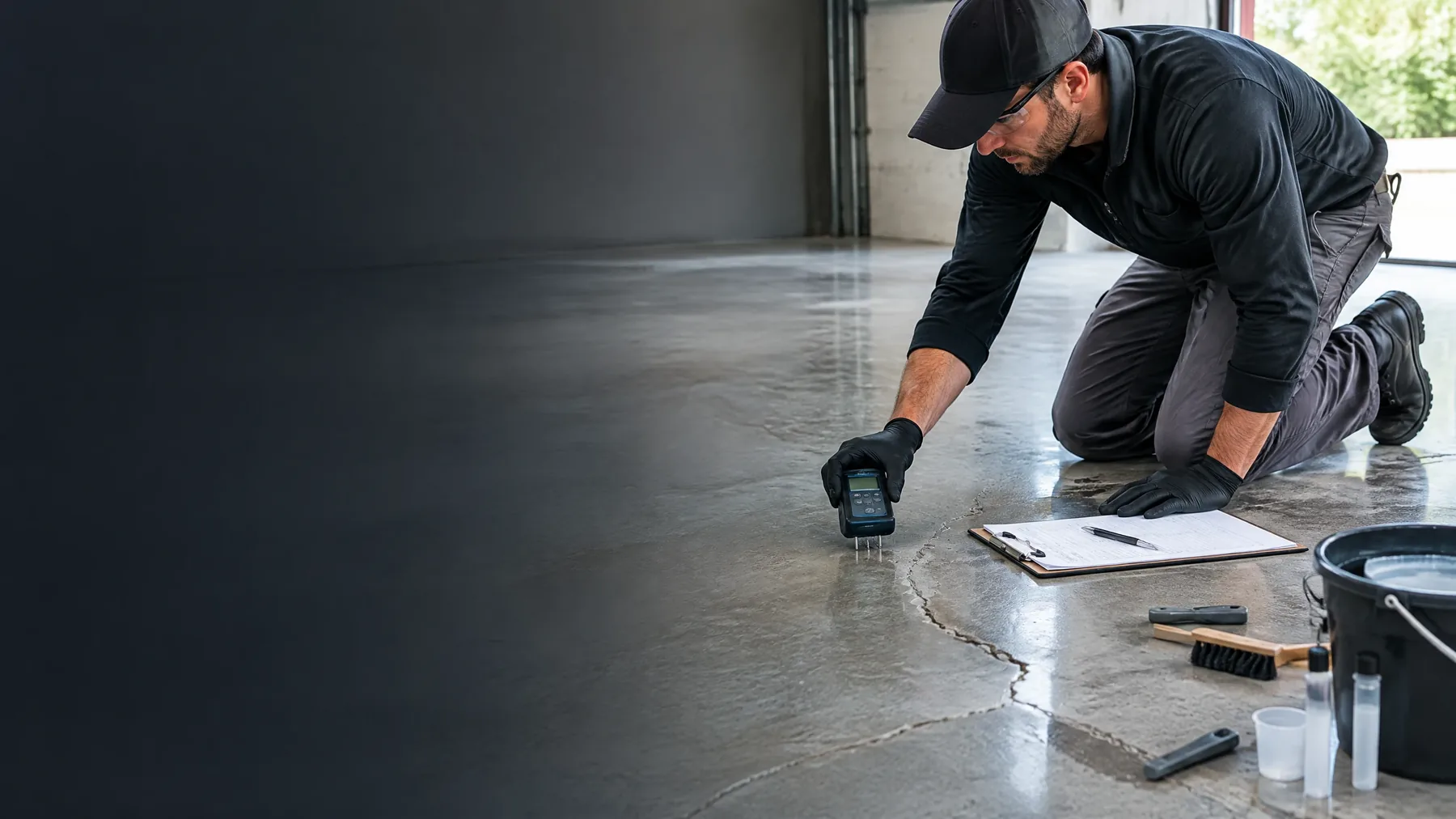
Testing the Slab for Moisture Before Any Garage Floor Coating
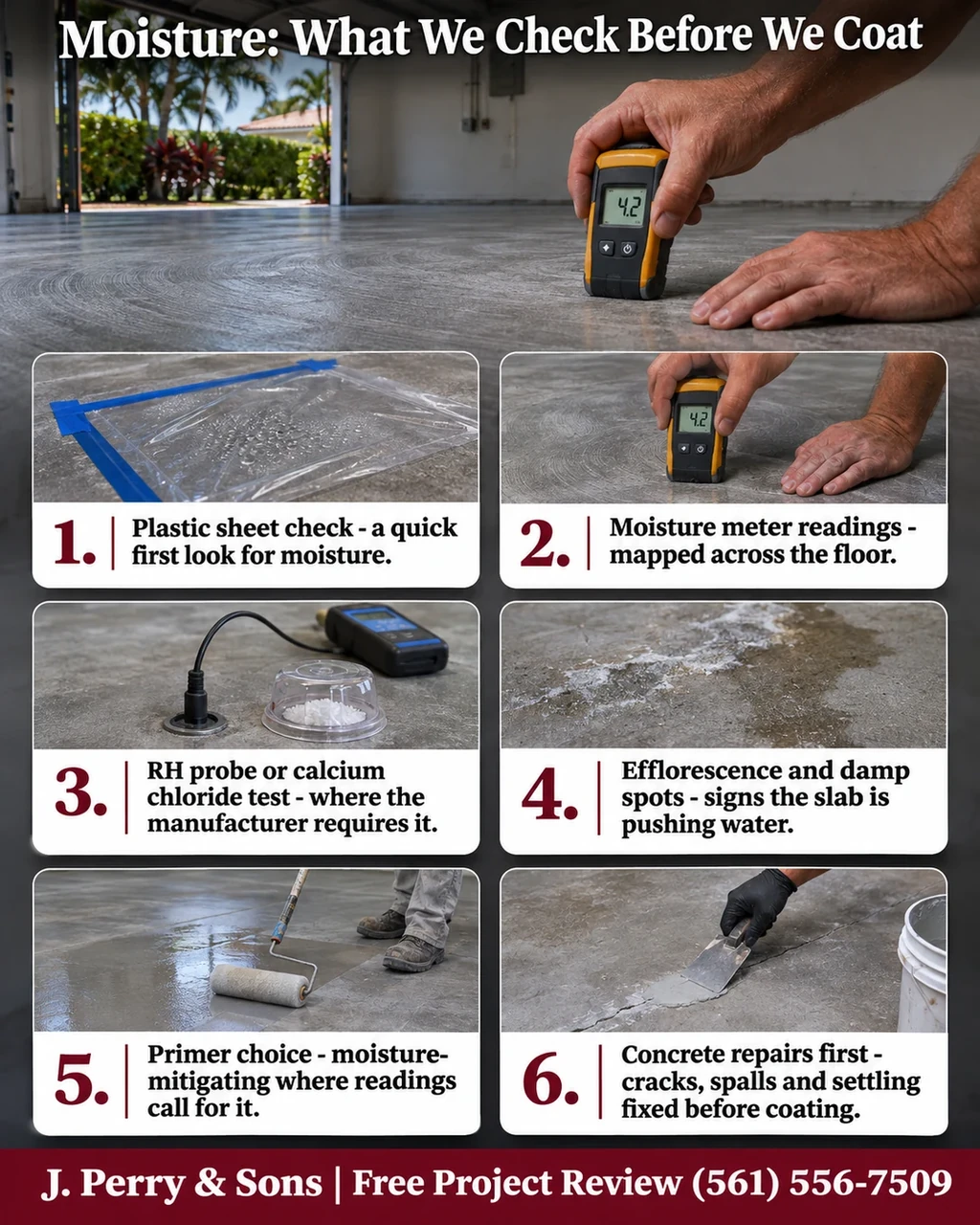
In South Florida, the slab under your garage is usually the deciding factor in whether a coating lasts. The water table is high, many garages sit on slabs with no vapor barrier below, and moisture moves up through the concrete all the time. A coating that seals the top of a wet slab traps that moisture, and the pressure lifts it off.
That is why we test before we choose the system, not after.
The plastic sheet check. A square of clear plastic is taped to the floor. If it fogs or the concrete under it darkens, the slab is pushing moisture. It is a quick first look, not a final answer.
Moisture readings. For a real number we use a concrete moisture meter across the floor, and where the readings are high, a relative humidity probe or a calcium chloride test as the coating manufacturer requires. The readings decide which primer the floor needs.
What the readings change. A dry slab gets a standard epoxy primer. A slab with high moisture gets a moisture-mitigating epoxy primer made for that condition, applied at the thickness the manufacturer specifies. Skipping it to save money is the most expensive mistake in garage floor epoxy.
Other warning signs. White powder on the concrete (efflorescence), dark damp spots near the door, old paint peeling in sheets and rust stains from rebar all tell us something about the slab. Each is noted before the proposal is written.
Near the coast. In waterfront homes, salt in the concrete and the air is another reason to prep deeper and choose the primer carefully.
If the slab itself is cracked, spalled or settling, the concrete is repaired first. See our residential concrete page for that work.
Next step: send us photos of your garage floor, including any stains or peeling, and we will tell you what we would test.
What Professional Garage Floor Contractors Use
- 100% solids epoxy (Mapei, Sherwin-Williams Macropoxy, Rust-Oleum Professional): Maximum film build, chemical resistance, and durability
- Polyaspartic (Penntek, Flexmar, ArmorPoxy): UV-stable, fast-cure, excellent for South Florida's sun exposure
- Moisture-mitigating epoxy primer: applied where moisture readings call for it, to prevent delamination from below
- Vinyl flake broadcast: Decorative chips that hide imperfections, add texture, and create a non-slip surface
- Clear polyaspartic top coat: UV-stable, abrasion-resistant final layer
The Best Epoxy for a Garage Floor Is a System, Layer by Layer
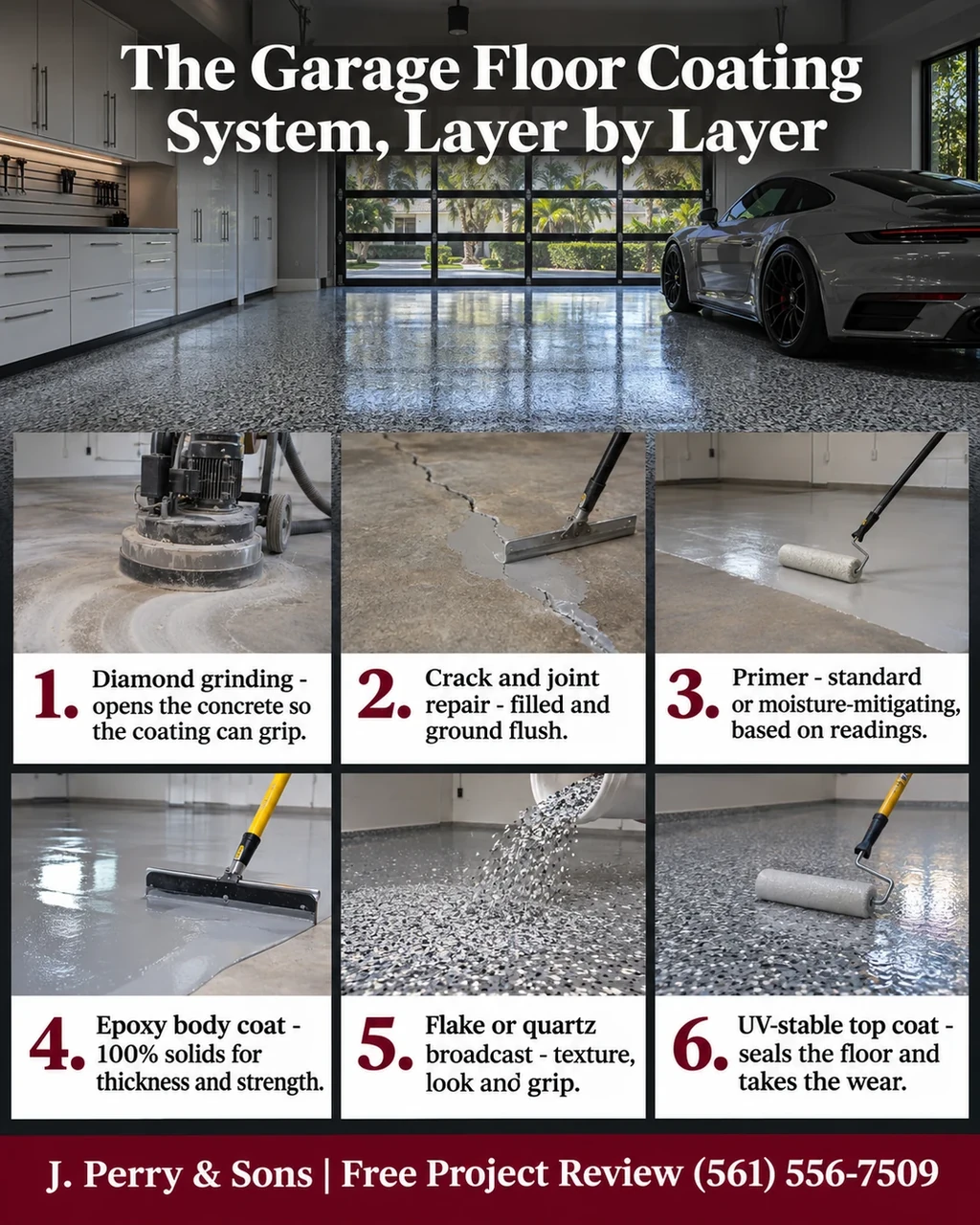
People ask us for the best epoxy for a garage floor as if it were one product in one can. It is not. A garage floor coating that lasts is a system of layers, and each one has a job. If one layer is wrong, the whole floor fails.
1. Diamond grinding. The concrete is ground with diamond tooling to open the surface and give the coating something to grip. Oil stains are degreased and, where they have soaked deep, ground out. Old coatings and sealers come off completely.
2. Crack and joint repair. Cracks and spalls are filled with an epoxy or polyurea repair material and ground flush. Control joints are a decision: we can fill them for a smooth look, or honor them so the slab can move. We go over that choice with you.
3. Primer. The primer is the bond to the concrete. It is either a standard epoxy primer or a moisture-mitigating primer, based on the moisture readings.
4. Body coat. A 100% solids epoxy body coat builds thickness and fills the profile left by grinding. This is the layer that gives the floor its strength and chemical resistance.
5. Broadcast. Flake or quartz is broadcast into the wet body coat, usually to full coverage, then scraped and vacuumed. This adds texture, hides small imperfections and sets the look.
6. Top coat. A clear, UV-stable top coat seals the broadcast and takes the wear. The choice between an epoxy and a polyaspartic top coat is covered in our polyaspartic vs. epoxy comparison.
Cove base and edges. A coved base, where the coating runs a few inches up the wall, makes the floor easier to clean and keeps water off the drywall.
This is the standard behind our residential epoxy flooring work.
Next step: ask us to show you the layers we would use on your garage during your Free Project Review.
Flake, Quartz or Metallic: Choosing the Garage Floor Finish
Once the system is right, the finish is the part you see every day. These are the three finishes we install most in luxury garages, and what each one is good at.
Full-broadcast flake. Decorative flakes are broadcast until no epoxy shows, then sealed. This is the most forgiving finish. It hides dust, tire marks and small slab flaws, and it gives a light texture underfoot. Flake size matters: small flakes read as a fine granite pattern, larger flakes read as bolder chips. Color blends can match cabinets, the house trim or a car collection.
Quartz broadcast. Colored quartz sand gives a tougher, more textured surface. It is the choice for garages that see heavy use, workshops and areas that get wet often, because it offers more grip.
Metallic epoxy. Metallic pigments are worked into the body coat by hand to create a deep, flowing, marble-like look. It is the showroom finish for collector garages and is also used inside the house. It is smoother than flake, so we add a slip-resistant additive to the top coat, and it shows scratches and dust more. Read more in our guide to metallic epoxy flooring.
Solid color. A solid color with a light anti-slip texture works for gyms, utility areas and clean modern spaces, but shows every speck of dust.
Texture and safety. Any garage that gets wet from a car coming in out of the rain should have a texture in the top coat. We set the level of grip with you before the top coat goes down.
Matching the house. If the garage opens to a mudroom or the house, the color is chosen with the interior floor in view. Our epoxy flooring page shows the finishes we offer.
Next step: tell us how you use your garage, and we will recommend the finish that suits it.
Garage Floor Options Beyond Epoxy
- Polished concrete: Seamless, modern, no coating to peel — the maintenance-free option for South Florida garages
- Interlocking floor tiles: Modular, DIY-friendly, no adhesive — popular for workshops and gyms
- Rubber flooring: Comfortable underfoot, anti-fatigue — popular for home gyms in garages
- Sealed concrete: Basic penetrating sealer — minimal investment, minimal protection
When a Coating Is Not the Right Garage Floor
Epoxy is not right for every garage. Sometimes another floor is the better choice, and we tell you when that is the case.
Porcelain tile. For a garage that is really an extension of the house, such as a car gallery, a gym or a finished workshop, a thick porcelain tile rated for vehicle traffic gives a high-end look and does not peel. The slab is leveled with a sand-and-cement mortar mix before setting. Porcelain garage tile is a strong option for these spaces.
Very wet slabs. If the moisture readings are beyond what any primer is rated for, a coating is a risk. In that case we explain the options in writing, including tile or a polished concrete finish.
Polished concrete. On a sound slab, grinding and densifying the concrete gives a durable, low-maintenance floor with no coating to fail.
What we do not recommend for luxury garages. Loose interlocking tiles and rubber mats have their place in a gym corner, but they trap water and dirt underneath and do not give the finished look most of our clients want.
Next step: if you are torn between epoxy and tile, send us photos of the garage and how it connects to the house, and we will give you our recommendation.
FAQ
What is the best epoxy for a garage floor in South Florida?
A 100% solids epoxy body coat over a primer chosen from moisture readings, with a flake or quartz broadcast and a UV-stable top coat. The brand matters less than the prep and the primer, because most failures come from moisture and poor bond, not from the epoxy itself.
Can you coat over my old garage floor epoxy?
Not as is. Peeling or poorly bonded coatings are ground off completely so the new system bonds to the concrete. Putting a new coating over a failing one only moves the failure up a layer.
Do you fill the cracks and joints in the slab?
Cracks and spalls are filled and ground flush before the coating. Control joints can be filled for a smooth look or left open so the slab can move. We go over that choice with you before work starts.
Is a flake garage floor slippery when wet?
A full-broadcast flake floor has a light texture and offers more grip than a smooth floor. For extra grip we add a slip-resistant additive to the top coat, and we set the level of texture with you.
Do you supply the coating materials?
Yes. J. Perry & Sons supplies all materials from preferred brands we work with, and the products for each layer are listed in your written proposal.
Epoxy, polyaspartic and microcement for garages, patios and businesses.
Free project review · (561) 556-7509