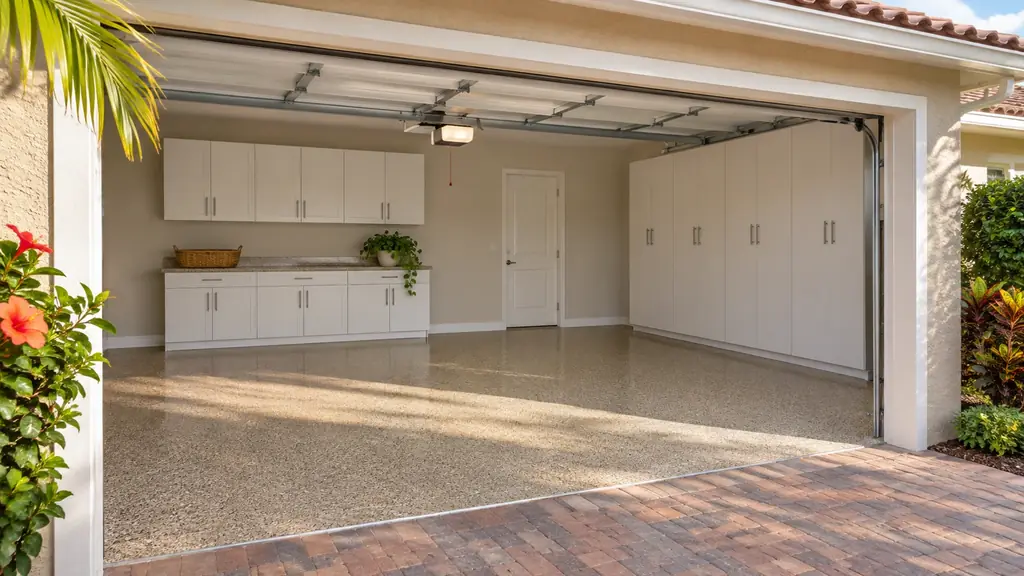
Is Your Boynton Beach Garage Floor Stained, Dusty or Peeling?
Most calls we get from Boynton Beach start the same way: the garage slab has oil spots that won't scrub out, a fine gray dust keeps tracking into the house, or a garage floor coating someone rolled on a few seasons back is now flaking off in sheets where the car tires sit. The concrete underneath is usually fine. What failed was the preparation and the product.
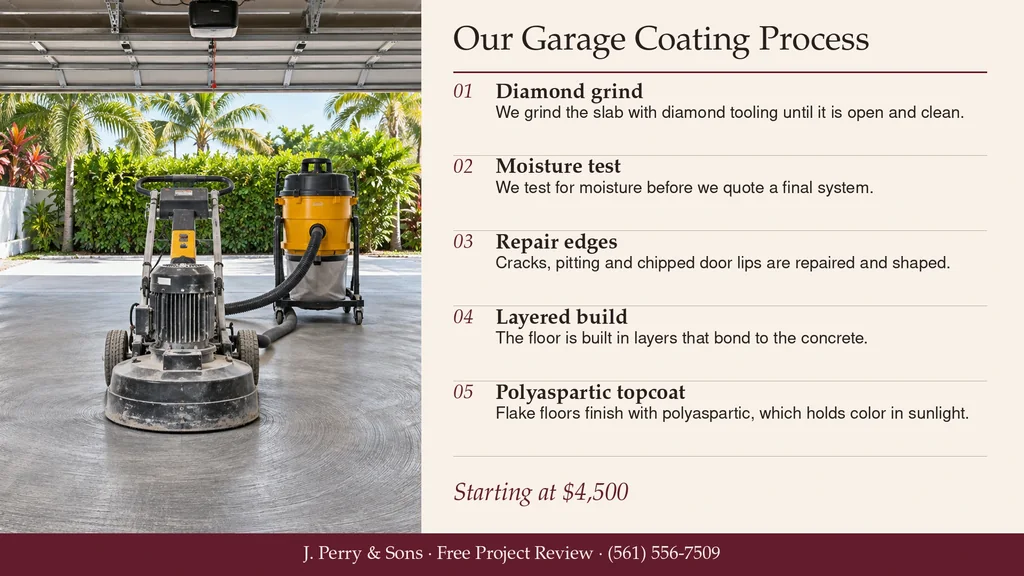
The fix is a real coating system, not a paint. We grind the slab with diamond tooling until it is open and clean, test it for moisture, repair cracks and pitting, and then build the floor in layers that bond to the concrete instead of sitting on top of it. The result is a surface you can hose off, park on and stop worrying about.
Boynton Beach Homes, Villas and HOA Rules
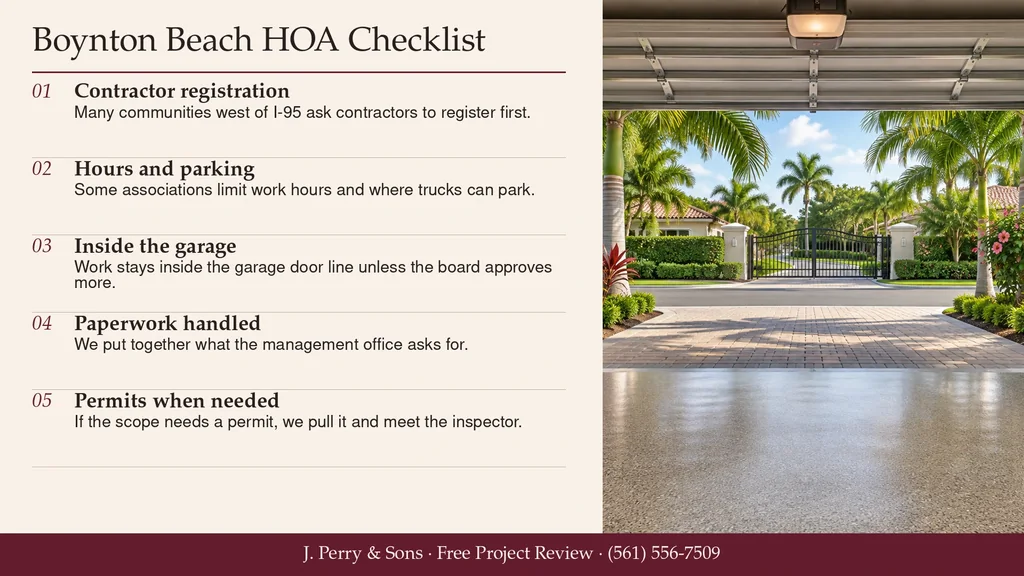
Boynton Beach covers a lot of ground. East of I-95 you find older single-family streets and condo buildings closer to the Intracoastal, where salt air and humidity work on every exposed surface. West of the interstate, most homes are in planned developments, many of them active-adult, with villas and single-family homes that share architectural rules.
In those communities the association usually wants to know who is working, when the crew arrives and how the driveway will look while the job is underway. We have handled HOA and condo work in Boynton Beach before, so we put together the paperwork the management office asks for and keep the work inside the garage door line unless the scope includes an outdoor area that the board has approved.
Palm Beach County sits outside the High-Velocity Hurricane Zone that governs Broward and Miami-Dade, but the Florida Building Code still applies, and the City of Boynton Beach reviews permits for work that requires one. For most interior garage coatings no structural review is involved, yet when your scope touches anything that does, we pull the permit and meet the inspector.
The Coating Systems We Install
Every Boynton Beach project starts with a sample board in your hand, not a picture on a phone. We bring physical chips and finish samples to the house, and when you want to see the whole room before committing, our designer prepares a rendering so you can compare colors against your cabinets and door.
The finish you choose sets how the floor looks and how much grip it has underfoot, which matters to a lot of our clients in the active-adult communities west of town.
- Solid color epoxy: a clean, uniform look for workshops, laundry rooms and storage areas.
- Full flake epoxy with a polyaspartic topcoat: the most popular garage floor we install, with texture that hides dust and gives better footing when the floor is wet.
- Metallic epoxy floor: a poured, marbled finish for show garages, game rooms and retail spaces.
- Commercial 100% solids epoxy: a thick, high-build system for businesses, warehouses and work bays.
Garage and Patio Floor Coatings: Epoxy, Polyaspartic and Polyurethane
How epoxy, polyaspartic and polyurethane compare for garages and patios.
Moisture Testing Before Anything Goes Down
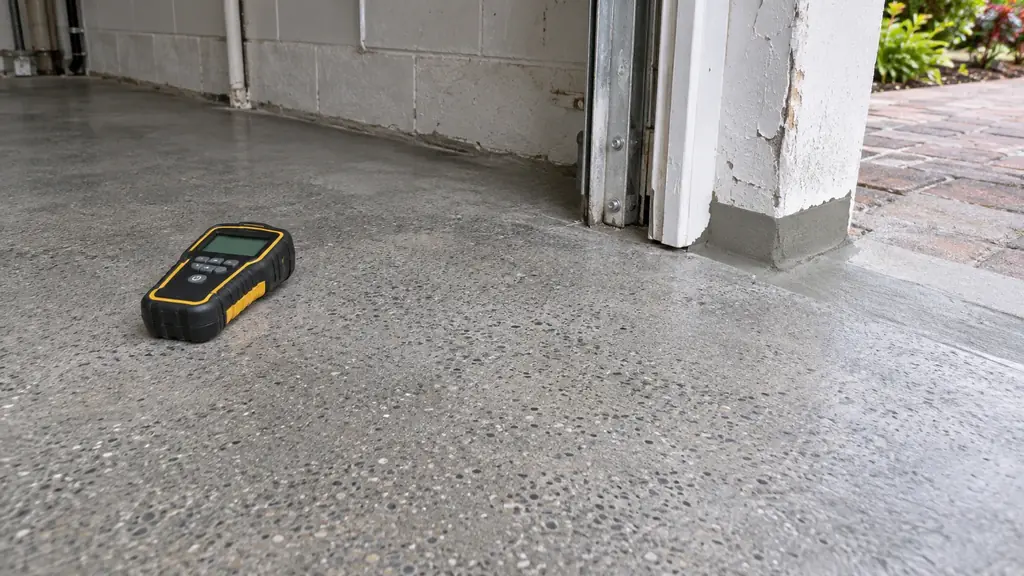
Concrete in South Florida breathes. Slabs here sit close to a high water table and absorb humidity from the air, and that vapor pushes up from underneath. If a coating goes over a slab that is releasing too much moisture, it blisters and lets go no matter how good the product is.
That is why we test before we quote a final system. If the readings are high, we adjust the primer and the build so the floor can handle what the slab is doing. If the old coating is failing, we remove it completely rather than coat over it, because a new layer is only as strong as what it is bonded to.
We also look at the edges. Garage slabs in older Boynton Beach homes often have a chipped lip at the door, a settled section near the driveway apron or a step down into the laundry room. Those spots get repaired and shaped before coating, because a clean, straight edge is what makes the finished floor look professionally installed rather than painted.
What Sets Epoxy Flooring Prices in Boynton Beach
How to Compare Garage Floor Coating Companies in Boynton Beach
Two quotes for the same garage can look nothing alike. One says "epoxy floor, two-car garage" and a price. The other lists grinding, moisture testing, crack repair, base coat, flake and topcoat. When you compare epoxy garage floor installers near you, these are the differences that decide whether the floor is still bonded years from now or peeling where the tires sit.
Grinding, not etching. A professional coating starts with diamond grinding to open the concrete so the primer bonds into it. Acid etching and a quick rinse leave a weak surface, and that is the most common reason a rolled-on floor lifts. Ask how the slab will be prepared, in writing.
A moisture test before the system is chosen. South Florida slabs push vapor up from below. A company that doesn't test can't know whether the floor needs a moisture-tolerant primer. We test first and write the readings into the system we propose.
Old coatings removed, not covered. If there is paint, sealer or a failing coating on the floor, it has to be ground off. Coating over it puts the new floor on a layer that is already letting go.
Full flake and the right topcoat. A full flake floor is broadcast until the base coat is covered, which gives texture, hides dust and adds grip. The topcoat matters just as much: in a west-facing Boynton Beach garage, a polyaspartic topcoat holds its color in sun better than standard epoxy. We compare the two in polyaspartic vs epoxy garage floors.
Cracks, edges and stem walls priced as lines. Crack and spall repair, the edge at the garage door and coating the stem walls should each be listed, so you know what you are paying for. Our residential epoxy page shows the full system, and garage epoxy floor cost breaks down the price by size.
Homes and businesses. As a concrete coating company we also install 100% solids commercial epoxy for shops, warehouses and service bays, scheduled around your operating hours.
Next step: Send a photo of your garage floor and the garage size, and we'll tell you which system fits your slab and the starting price.
After the project review, your written proposal lists the following scope and pricing: A two-car garage floor. From there the number is based on the actual square footage, the condition of the slab, whether an old coating or sealer has to be ground off, how much crack and spall repair is needed, the moisture readings, and the system you pick. A metallic floor or a commercial-grade build costs more than a full flake garage because of the material and the labor involved in placing it.
Coating the stem walls at the base of the garage, adding a cove at the edges, or carrying the finish onto a covered patio are also part of the review. We put every line in writing after we see the slab, so the proposal matches the floor you actually have. Written out this way, you get a clear picture of epoxy garage floor cost for your own slab rather than a guess based on someone else's garage.
Book a Free Project Review in Boynton Beach
Plenty of our Boynton Beach clients split the year between Florida and somewhere up north. That works fine with us: you can be in another state while the crew is in your garage. We set up access through you or the gatehouse and text you photos and a progress note each evening, so when you return, the floor is done, the garage is swept and your things can go back in. In short, you come back to it finished.
To start, call (561) 556-7509 or use the form below. We will look at the slab, take moisture readings, show you samples and follow up with a written proposal for the system that fits how you use the space.
Services We Offer in Boynton Beach
Why Boynton Beach Homeowners Choose J. Perry & Sons
Neighborhoods We Serve in Boynton Beach
Call (561) 556-7509 or send us your project with photos, the city, approximate dimensions, and material selections.
Epoxy, polyaspartic and microcement for garages, patios and businesses.
Free project review · (561) 556-7509
Epoxy Flooring in Boynton Beach — FAQ
Does my Boynton Beach HOA need to approve garage floor epoxy?
Is a flake garage floor slippery when it gets wet?
Can you put epoxy over the paint or sealer already on my garage floor?
Will the sun coming through my garage door yellow the floor?
Do you coat floors for businesses in Boynton Beach too?
How much does an epoxy garage floor cost in Boynton Beach?
How long before I can park on a new garage floor?
Can you coat a covered patio or a pool deck in Boynton Beach?
Share your vision for your South Florida home.
Free project review · (561) 556-7509