"Our driveway is cracked, the garage floor is pitted and the patio has spots where the surface is flaking off. Do we have to tear it all out, or can it be fixed?"
Short answer: most cracked, spalled or worn concrete around a South Florida home can be repaired and resurfaced instead of replaced, as long as the slab underneath is sound. The work goes in a fixed order: find the cause, repair the cracks and spalls, prepare the surface, then put down the finish that fits how the area is used (an overlay, a coating, a polished finish, tile or pavers). Replacement is the right answer when the slab has settled, keeps cracking through every repair or has lost its strength. After the project review, your written proposal lists the following scope and pricing: Spall repair where the steel is exposed repaired. J. Perry & Sons concrete restoration handles the repair and the new surface on one job, and we pull the permit when the work calls for one.
This guide is for homeowners looking at driveways, garage floors, patios, walkways, entry steps and pool decks. If you manage a condo or commercial building and have an engineer's report in hand, the commercial concrete page is written for you.
The Owner's Guide to Epoxy and Concrete Floors
How to choose the right coated or polished floor and what makes it last.
Why South Florida concrete wears out
Concrete here does not freeze, but it takes a different kind of beating. Strong sun heats the surface every day and afternoon storms cool it fast. Humidity and rain keep the slab wet much of the year. Near the coast, salt air settles on everything. Sprinklers soak driveways and patios every night, and pool water and chlorine splash onto decks. Each of those cycles opens small cracks a little wider and lets water move deeper into the slab.
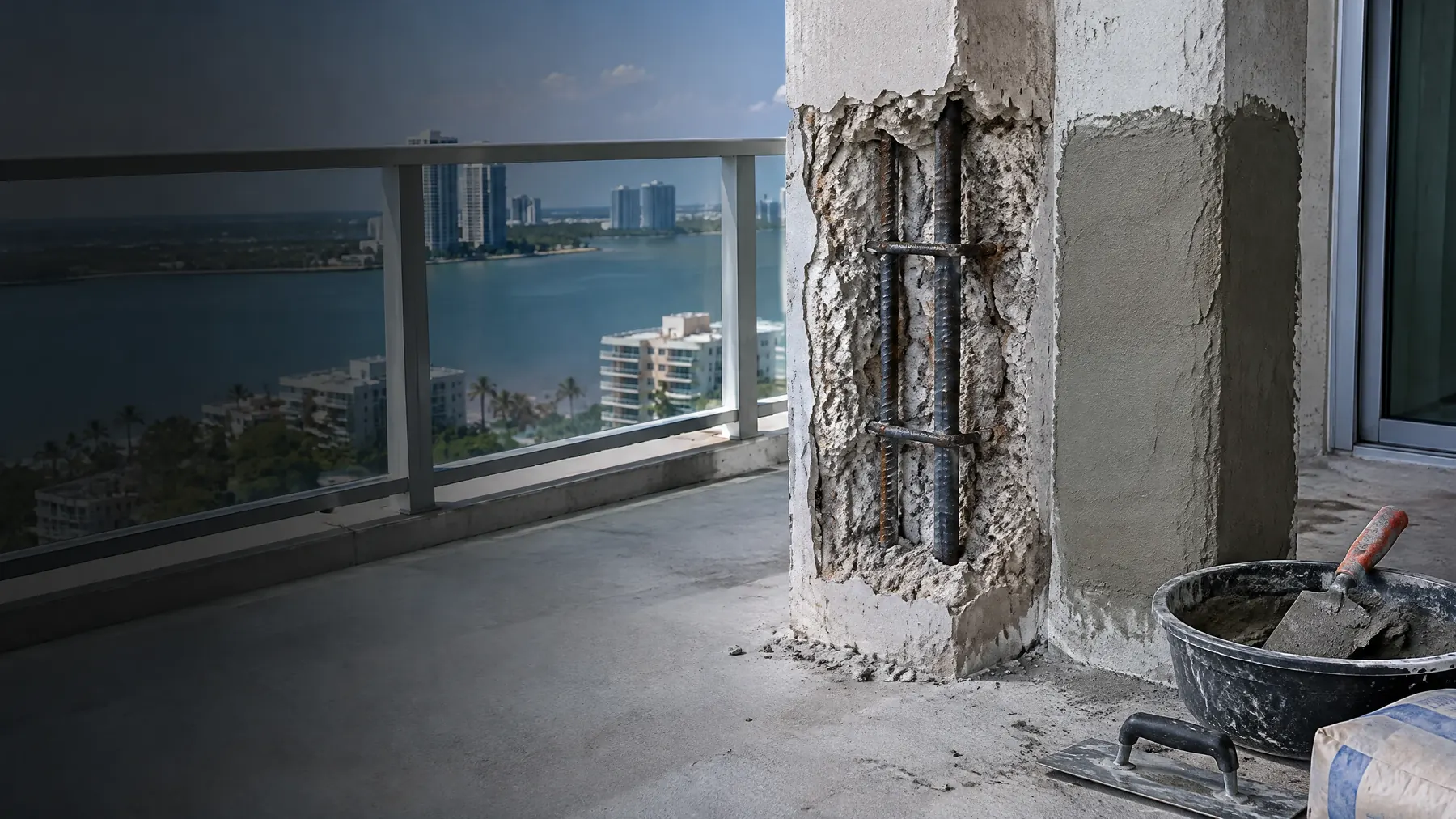
Two things follow. On the surface, the top layer weakens, scales and dusts. Inside the slab, water and chlorides reach the steel reinforcing or wire mesh, the steel rusts, and rust takes up more room than steel. That pressure pushes the concrete off from the inside, which is what most people call spalling. Once it starts, it lets in more water and speeds itself up.
The good news is that both problems can be caught and repaired, and the earlier the repair, the smaller it is.
Next step: walk the slab after a rain and take photos of where water sits and where the surface is breaking up. Those two things tell us most of the story.
The six problems we see most, and what each one means
Not every flaw is the same problem. Before anyone talks about a finish, you need to know which of these you have.
- Surface cracking. Hairline cracks from shrinkage and thermal movement are normal and mostly cosmetic. Wider cracks, cracks with one side higher than the other, or cracks that keep growing point to settlement or overload.
- Spalling. Pieces of the surface break off, often with rust stains or exposed steel. On a driveway or deck slab this usually means corroded mesh or rebar near the surface. Spalling is also caused by a poor original mix or finish.
- Delamination. The top layer separates from the slab below. You hear it before you see it: tap with a hammer and the area sounds hollow. Improper finishing and moisture vapor are the usual causes.
- Scaling. The surface flakes in thin patches. Pool chemicals, fertilizers and harsh cleaners attack the paste at the top of the slab.
- Dusting. A chalky, powdery surface that never stays clean, caused by poor curing when the slab was poured or by carbonation over the years.
- Staining. Oil, rust from irrigation water, efflorescence (the white salt bloom from water moving through the slab) and mildew. Staining is a surface issue, but rust stains along a line can be the first sign of steel corroding underneath.
Next step: if you see rust stains following a straight line, send a close-up. That pattern often means steel near the surface, and it changes the repair.
Cosmetic or structural: how to tell the difference
This is the question that decides everything else. A hairline crack under about 1/8 inch, with both sides level, is usually cosmetic. It can be cleaned, filled and resurfaced. A crack wider than about 1/4 inch, a crack with vertical displacement (one side higher), or a crack that has opened since last year is a sign the slab or the soil below is moving. Those need the cause looked at before any repair, and where the concrete is structural (a raised slab, a balcony, an elevated walkway or a beam), the repair is designed by a licensed engineer and we build to it.
We are the contractor, not the engineer. On a home, most driveway, patio and garage problems are not structural and do not need an engineer. When something is, we tell you plainly, and we work to the engineer's details. For raised slabs, balconies and building elements, see balcony repair and spalling concrete column and beam repair.
Next step: lay a coin or a credit card next to the widest crack and photograph it. That gives us a scale.
How we repair and resurface concrete, step by step
Skipping steps is why many resurfacing jobs fail. This is the sequence we follow.
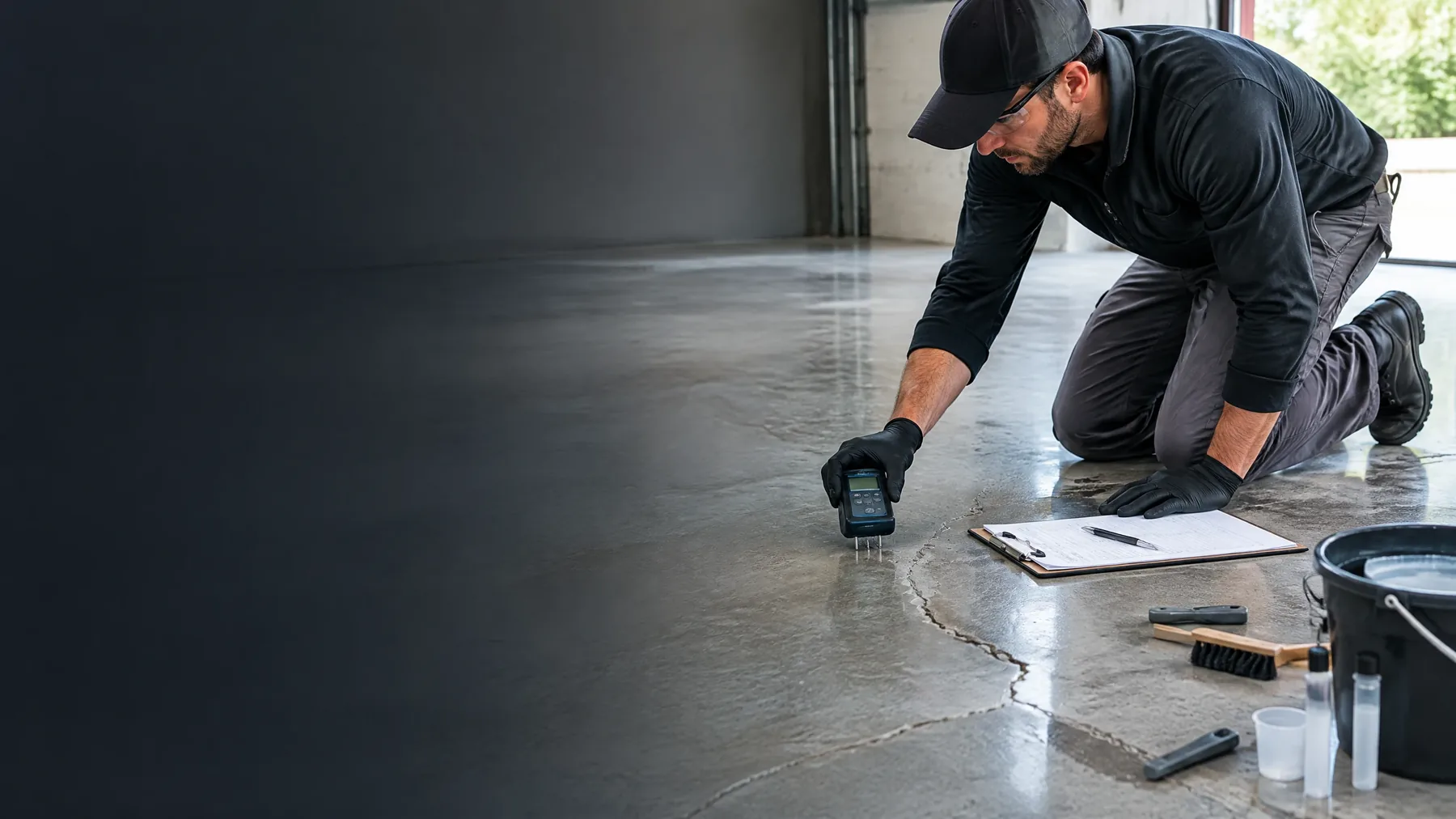
- Assessment. We identify each crack as cosmetic or structural, sound the slab for hollow areas, check how water drains, and test for moisture where a coating is planned. Moisture vapor coming up through a slab is the most common reason coatings peel.
- Surface preparation. Diamond grinding or shot blasting removes loose material, old coatings, sealers and contaminants. A new surface bonds only to clean, open concrete. Acid washing is not a substitute.
- Crack repair. Structural cracks get epoxy or polyurea injection or a rigid filler, chosen for the crack. Cracks that will keep moving with temperature get a flexible sealant instead, because a rigid fill in a moving crack just cracks again. Control joints are cleaned and resealed; see expansion joint sealing.
- Spall repair. Loose concrete is saw-cut square and chipped back to sound material. Exposed steel is cleaned to bare metal and coated with a corrosion inhibitor. The area is rebuilt with a polymer-modified repair mortar, feathered or formed to match the surrounding surface.
- Resurfacing. Once the slab is sound, the new surface goes down: a cement overlay, an epoxy or polyaspartic coating, a polished finish, or a set finish such as tile or pavers. Each has its own cure time before traffic, which we follow.
- Sealing. A penetrating sealer on exterior concrete that has to breathe, or a topical sealer or topcoat on interior and garage floors.
Next step: if you have had a coating peel before, tell us when you send photos. It usually means a step above was skipped, and we plan around it.
Choosing the new surface
The finish is the part you see, so it is where most owners start. It should be the last decision, made after the slab is known to be sound.
- Cement overlay. A bonded layer that renews a worn or scaled slab. It can be plain, broom-finished for grip, or tinted and textured. Good for driveways, walkways and patios.
- Epoxy or polyaspartic coating. The standard for garage floors and some interior spaces. Flake systems hide dust and give grip. Our epoxy flooring page covers the systems, and the guides on garage floor epoxy and polyaspartic vs. epoxy compare them. In South Florida, a moisture-blocking primer goes under every coating, because vapor pushing up through the slab is what lifts it.
- Polished concrete. Grinding and polishing the slab itself, for interiors where the concrete is in good shape. See polished concrete flooring.
- Tile or porcelain pavers over the slab. For patios, lanais and pool decks where you want a finished floor rather than a coated slab. See porcelain patio tile over concrete and porcelain pavers.
- Pavers over the existing concrete. For driveways and walkways that are sound but tired, a paver overlay changes the look completely without tearing out the slab. See pavers over existing concrete.
For pool decks specifically, including Cool Deck and spray texture, see pool deck resurfacing.
Next step: send a photo of the look you want next to a photo of the slab today, and we will tell you which system gets you there.
When to repair and when to replace
Resurfacing is a finishing step, not a fix for a bad slab. We recommend replacement, or a new surface built over a corrected base, when:
- The slab has settled or heaved, and water runs toward the house or sits in the middle.
- Cracks come back through every repair and coating.
- Large areas sound hollow or the concrete crumbles when chipped.
- Tree roots have lifted sections.
- The driveway was poured too thin for the cars and trucks that use it.
Replacement costs more up front, but it is cheaper than resurfacing twice. If the old slab has to come out, our article on concrete removal cost explains what goes into that part of the job. We focus on replacement and new installation, and we take repair work when it is the right money for the owner. When a repair-only job is not worth it, we say so.
Next step: tell us how long the cracks have been there and whether they have grown. That one detail moves a job from repair to replace more often than anything else.
Area by area: driveways, garages, patios and pool decks
Driveways. Most driveway damage is surface wear, oil staining and cracks at the control joints and the apron. A sound driveway takes an overlay, a sealer or a paver overlay. A driveway with sunken sections or root damage is usually replaced. See residential concrete for the full residential scope.
Garage floors. Garage slabs dust, stain and pit. The most common upgrade is a ground, repaired and coated floor. After the project review, your written proposal lists the following scope and pricing: A two-car garage coating.
Patios and lanais. Covered lanais often have a sound slab and just need a new surface. Open patios take more sun and rain and need the slope checked first. If the patio is bare concrete and you want a polished, low-care finish outside, porcelain or stone is usually the better long-term choice than a coating.
Pool decks. Decks take chlorine, salt, sun and bare feet. Cracks and settlement are fixed first, then the surface. Heat matters: light, cool surfaces beat dark coatings.
Entry steps and walkways. Chipped nosings and spalled edges are a trip hazard. See our guide to concrete stair restoration and a new tile or stone finish.
Next step: if more than one area needs work, send them together. One mobilization for the driveway, walkway and patio is better value than three.
Permits and HOA rules
Cosmetic resurfacing and coating usually need no building permit. Structural concrete repair, a new driveway apron where it meets the street, work that changes drainage, and any work on a raised or elevated slab often do. J. Perry & Sons pulls all permits itself and follows city and county requirements; our permits and compliance page explains how. Many HOAs regulate driveway and front-yard finishes, so we prepare the color, product sheet and layout for the association before work starts.
Next step: tell us your city and whether you have an HOA when you send your project.
Concrete resurfacing cost in South Florida
Pricing is based on the area, the condition found when the surface is opened, the repairs needed and the finish you choose. After the project review, your written proposal lists the following scope and pricing: Spall repair where the steel is exposed repaired. After the project review, your written proposal lists the following scope and pricing: A two-car garage floor coating. For overlays, polished finishes and full driveway or pool deck resurfacing, pricing is given in the itemized written proposal after your Free Project Review, with prep, crack repair, spall repair, surface and sealer on separate lines. We review every project personally and follow up with you directly.
Licensed Florida general contractor CGC1540699, licensed and insured, with a certificate of insurance on request. 150+ projects completed.
Concrete resurfacing by city
We resurface and coat concrete across Broward, Palm Beach and Miami-Dade. City pages for coated floors: Epoxy flooring in Miami · Epoxy flooring in Boca Raton · Epoxy flooring in Fort Lauderdale · Epoxy flooring in West Palm Beach · Epoxy flooring in Coral Gables · Epoxy flooring in Weston · Epoxy flooring in Hollywood · Epoxy flooring in Pompano Beach · Epoxy flooring in Delray Beach · Epoxy flooring in Boynton Beach · Epoxy flooring in Wellington · Epoxy flooring in Parkland
More from the journal: 2026 kitchen design trends in South Florida · Best slab materials for South Florida homes
FAQ
Can cracked concrete be resurfaced without replacing it?
Yes, when the slab is sound. The cracks are repaired first, with a rigid fill for cracks that have stopped moving and a flexible sealant for cracks that move with temperature, and then the new surface goes on. If the slab has settled or the cracks keep returning, resurfacing will not hold and replacement is the better spend.
What causes concrete spalling in Florida?
Mostly rusting steel. Water and salt reach the mesh or rebar through cracks, the steel rusts and expands, and it pushes the concrete off. Poor original finishing and harsh chemicals cause surface scaling that looks similar. The repair is to cut back to sound concrete, treat the steel and rebuild with repair mortar.
How much does concrete spall repair cost?
After the project review, your written proposal lists the following scope and pricing: Spall repair where the steel is exposed repaired. The final price is based on the depth, the amount of steel affected and what is found once the concrete is opened. Surface-only resurfacing is priced in the itemized written proposal.
Will a coating fix my pitted garage floor?
A coating covers it only if the floor is ground, repaired and primed first. Pits and spalls are filled, cracks are treated, and a moisture-blocking primer goes down before the coating. Skipping the prep is why many garage coatings peel. After the project review, your written proposal lists the following scope and pricing: A two-car garage coating.
Do I need an engineer for concrete repair?
For most driveways, patios and garage floors, no. For cracks with displacement, raised slabs, balconies and structural elements, yes. The engineer designs the repair and we build to it.