"Our concrete driveway is cracked all the way across, the apron is barely wide enough for one car, and everything out here gets a salt film no matter how often we hose it off. If we spend the money on pavers, how do we keep them looking new this close to the beach?"
Most of the paver installation Pompano Beach owners ask us for is on homes within a couple of miles of the ocean, where salt, sand and canal water decide which material lasts and how it has to be cared for. The good news: pavers are one of the best surfaces for a coastal home, because they flex with sandy soil instead of cracking across, and a damaged piece can be lifted and replaced.
Short answer: J. Perry & Sons builds driveways, pool decks, patios and walkways in pavers across Pompano Beach, in concrete, travertine and 2 cm porcelain, on a base built for sandy coastal soil. After the project review, your written proposal lists the following scope and pricing: Concrete paver driveways start at $29 per sq ft installed, travertine pool decks with the stone included, and porcelain patios and dock decks. As a licensed and insured renovation contractor in Pompano Beach, based nearby in Tamarac, we handle demo, coping, permit and sealing as one company.
Free Project Review · Call (561) 556-7509
150+ projects completed · Licensed Florida general contractor CGC1540699 · Workmanship warranty · Certificate of insurance on request
Licensed and insured. Certificate of insurance available on request.
Paver Installation Cost in Pompano Beach
Starting prices, installed, with demolition, fabric, compacted limerock, bedding sand, edge restraint and polymeric sand included.
| Scope | Starting price |
|---|---|
| Concrete paver driveway, 80 mm | Starting at $29 per sq ft |
| Clay brick pavers | Starting at $31 per sq ft |
| Pool coping | Starting at $80 per linear ft |
Waterfront lots with soft fill can need a thicker base, which we quote as its own line rather than hiding it in the square-foot price. Your final price is based on the lot, the material, access and the full scope of work, and it is confirmed after we review your project.
Planning the coping too? Our guide to pool coping installation cost explains what goes into that number.
Next step: send a photo of the driveway from the street, showing the apron and the swale.
Pompano Beach homes and what that means for pavers
Pompano's housing is mostly 1950s through 1970s CBS homes: modest ranches farther inland, canal-front homes between the coast road and the Intracoastal, and condos and townhomes along the beach. A typical single-family job here is a cracked 4 inch concrete driveway with a narrow apron, a small pool deck, and a patio that stops at the canal or the seawall cap.
That 4 inch slab is the starting point for most of our Pompano driveways. Poured decades ago, often without much reinforcement, it cracks as the sandy soil underneath shifts and as tree roots push up from the side. Patching it rarely lasts. Replacing it with pavers fixes the cracking for good, because a paver field is made of thousands of small units that move slightly with the ground instead of breaking.
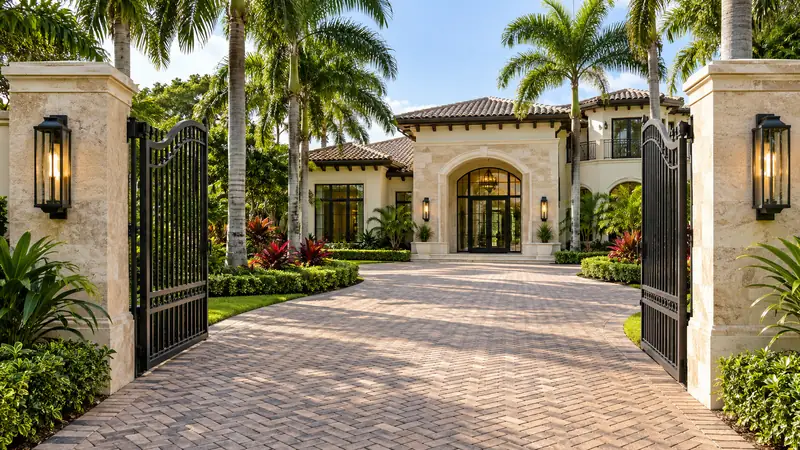
When we replace one of these driveways, owners often want it wider. Widening the apron means a right-of-way permit, and we file it. We remove the old slab, haul it away, compact the subgrade, and build the new base. All driveways get 80 mm pavers in a herringbone field with a soldier course border, which locks the field against turning tires. More on layouts and borders is on paver driveway.
Next step: tell us if you want the driveway wider than it is today, so we can check the right-of-way before we price it.
Sandy soil: why the base matters more near the beach
Sandy coastal soil drains fast, which is good for pavers. It also shifts if the base on top of it is thin, which is why so many coastal paver jobs develop dips at the apron and along the edges.
Here is how we build for it:
- Compact the subgrade. We excavate to depth and compact the exposed sand before anything goes on it. Organic soil and old roots come out.
- Lay geotextile fabric. A woven fabric keeps the limerock from migrating down into the sand. On coastal soil this is one of the most important layers in the job.
- Build the limerock base in lifts. Driveways get 6 to 8 inches of compacted limerock, patios and pool decks 4 to 6, each lift wetted and compacted before the next.
- Screed one inch of bedding sand. Too much sand is the second most common cause of ruts, so we keep it at one inch.
- Lock every edge. A concrete toe or curb on driveways and a hard edge restraint on patios. In sandy soil, an unrestrained edge is where the field starts to spread.
- Fill joints with polymeric sand. It hardens when activated with water and resists wash-out from wind-driven rain.
On canal lots we leave a sealed joint where pavers meet the seawall cap so the two can move separately. Butting pavers against the cap is what cracks the edge row.
Salt: choose the right material, then keep it clean
Salt is the first thing we plan around. Within a mile or so of the ocean, salt spray and salt-system pools etch soft stone and discolor some concrete pavers. Travertine and porcelain hold up best, and we steer clients away from marble on exposed decks near the water. Our comparison of travertine vs marble vs porcelain pavers covers the details.
Choosing the right material is half of it. The other half is care, and coastal pavers need a simple routine:
- Rinse regularly. A fresh-water rinse washes salt film off the surface before it builds up in the pores of the stone. It matters most after storms that carry spray inland.
- Seal on schedule. Travertine and concrete pavers within reach of salt air should be resealed every few years, sooner on the most exposed surfaces. The first sealing waits until the material has cured: about 30 to 60 days for travertine and 60 to 90 days for concrete pavers, so the white efflorescence haze can wash out first.
- Pick the right sealer. A penetrating sealer for travertine; a natural or wet-look finish for driveway pavers. Never a gloss finish on a pool deck, because it gets slick.
- Skip sealing on porcelain. Porcelain absorbs almost no water, so it never needs it. That is a big reason owners on the most exposed lots choose it.
- Re-sand when joints open. If joint sand starts to wash out, top it up before weeds or ants move in.
Our paver sealing guide goes deeper on products and costs, and if your pavers are already faded or sinking, see paver repair and sealing.
Next step: if your current pavers are faded or stained, send a photo. Many can be cleaned, re-sanded and sealed instead of replaced.
Travertine paver installation in Pompano Beach
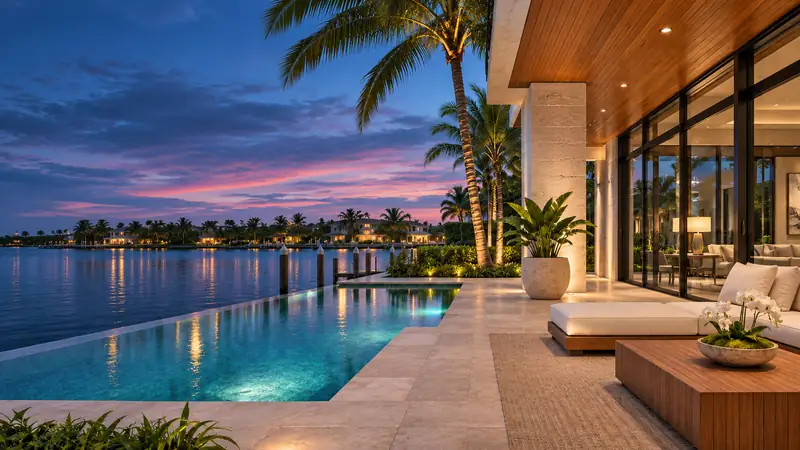
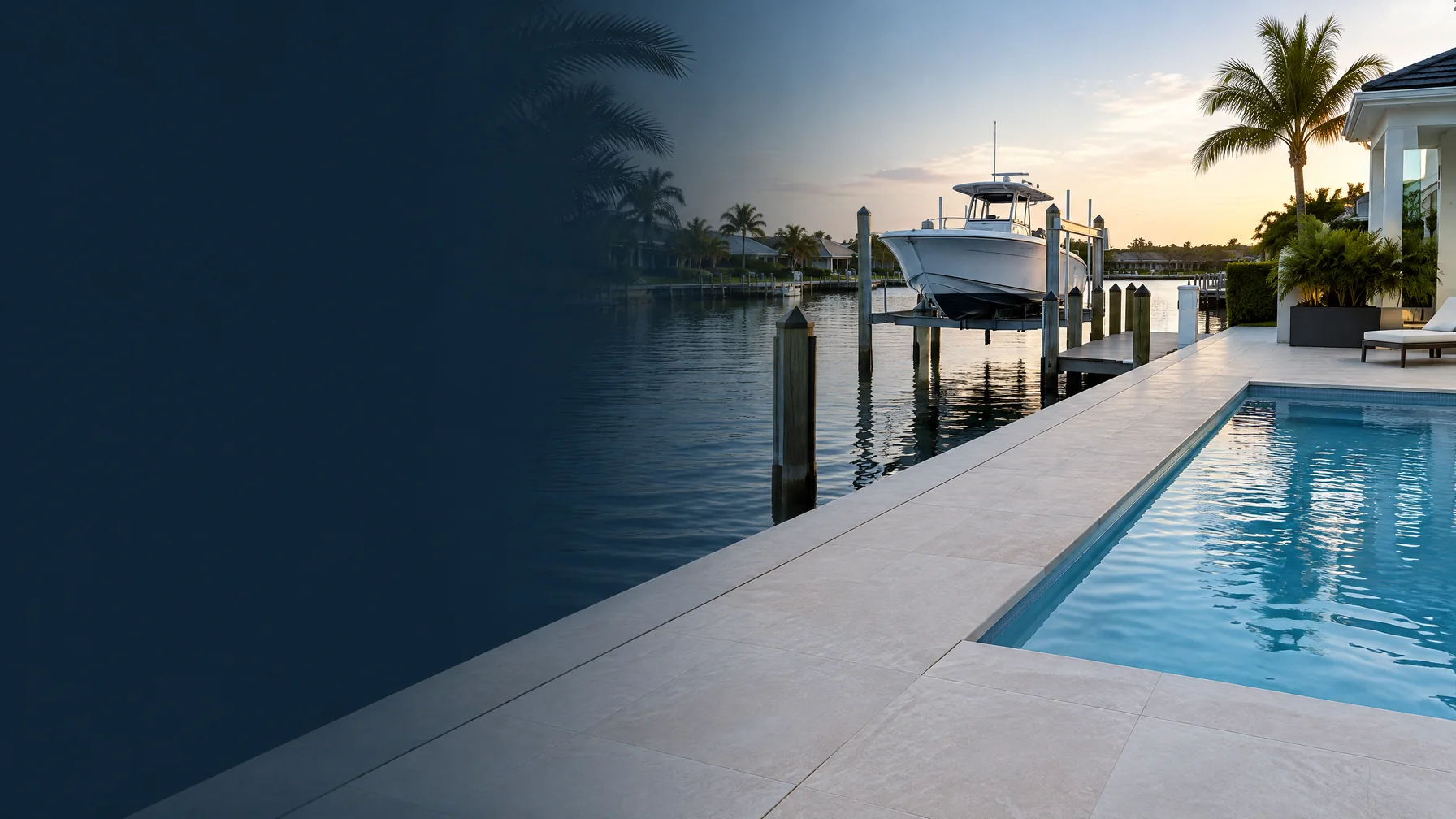
For a canal-side pool deck in Pompano, travertine is the stone we recommend most because it tolerates salt air and chlorinated splash far better than marble and stays comfortable barefoot in August. We set travertine pavers at 1¼ inch on new base for decks that see heavy furniture and grills, or ¾ inch over a sound slab where the existing deck can stay. Silver and ivory tones are popular near the water because they stay cooler and hide salt residue. Coping is matching bullnose set on the beam. After the project review, your written proposal lists the following scope and pricing: Travertine pool decks and travertine driveways installed, and a penetrating sealer goes on after the stone has cured.
Pompano pool decks are often small, so the step from concrete pavers to stone adds less to the total than many owners expect. When the pool needs more than a deck, we combine deck, coping and waterline tile as one pool remodeling project. The full deck system is on pool deck pavers, and coping options are on pool coping.
Townhomes and condos along the beach
Own a townhome or a condo unit with a private patio? Most associations require approval before you change anything on the exterior, even a patio inside your fence. We prepare the request with you: the paver, color, pattern and a sketch, plus product sheets. Common-area decks are a different job: they need board approval and are handled on our commercial pavers and HOA pool decks page.
Permits and trees
Driveway apron work in the right-of-way, widening and full pool deck rebuilds need a permit, and condo associations along the beach have their own approval process for any common-area deck. We confirm with the Pompano Beach building department before setting a start date. J. Perry & Sons pulls the permit, schedules the inspections, and builds to the city and county codes that apply, including the High-Velocity Hurricane Zone requirements that cover Broward County where they apply.
Older trees are the other factor. Black olives and ficus planted decades ago lift paver edges along the street and the side yard. We cut roots inside the footprint and add a root barrier on the tree side.
How we do it in Pompano Beach
- Site visit to measure, check the seawall cap, drainage toward the canal or swale, and how close the ocean air is.
- We review every project personally and follow up with you directly.
- City permit and any condo or HOA approval filed before demo.
- Demo and haul-off, pool protected, irrigation and dock lighting lines marked.
- Subgrade compacted, fabric laid, limerock compacted in lifts, sand screeded.
- Coping bedded on the beam, field set and cut wet, edges restrained, polymeric sand compacted in, expansion joint at the seawall.
- Sealing visit after cure, with our written workmanship warranty.
Each scope in detail: paver driveway · pool deck pavers · pool coping · paver repair and sealing.
Related services in Pompano Beach
Tile Installation in Pompano Beach
Bathroom Renovation in Pompano Beach
Kitchen Renovation in Pompano Beach
Epoxy Flooring in Pompano Beach
Flooring Installation in Pompano Beach
Nearby service areas
Paver Installation in Fort Lauderdale
Paver Installation in Parkland
Paver Installation in Hollywood
Planning guides: Travertine vs Marble vs Porcelain Pavers · Paver Sealing Guide · Pool Coping Installation Cost
Serving Pompano Beach ZIP codes 33060, 33062, 33064 and 33069.
Paver and stone driveways laid on a base built to stay level.
Free project review · (561) 556-7509
Paver Installation in Pompano Beach — FAQ
Which pavers last best this close to the ocean?
Travertine and 2 cm porcelain. Marble etches from salt spray and salt-system water, and unsealed concrete pavers fade in direct coastal sun. Porcelain is the lowest-maintenance choice because it never needs sealing.
Does Pompano Beach require a permit for a paver pool deck?
A full deck removal and rebuild does, and it brings a pool barrier inspection. An overlay on a sound existing deck often does not. Driveway aprons and widening always do. We confirm with the building department and pull the permit.
My driveway is cracked concrete. Can pavers go over it?
Only if the slab is flat, sound and not settling, and the added height works at the garage and the street. Most old 4 inch driveways in Pompano are cracked through, so we remove them and build a new base. It costs more up front and it is the version that lasts.
Can you install pavers on a condo pool deck?
Yes, working with the association and its manager. Common-area decks need board approval, and we phase the work around pool closures to keep disruption down for residents. Your schedule is confirmed in the written proposal.
How often should coastal pavers be sealed?
Every few years for travertine and concrete pavers within reach of salt air, sooner on the most exposed lots, after the first sealing that waits for the material to cure. Porcelain never needs sealing.
How do I get an exact price?
Start with a Free Project Review. Send photos and rough dimensions through our project form or call (561) 556-7509. We review every project personally and follow up with you directly.